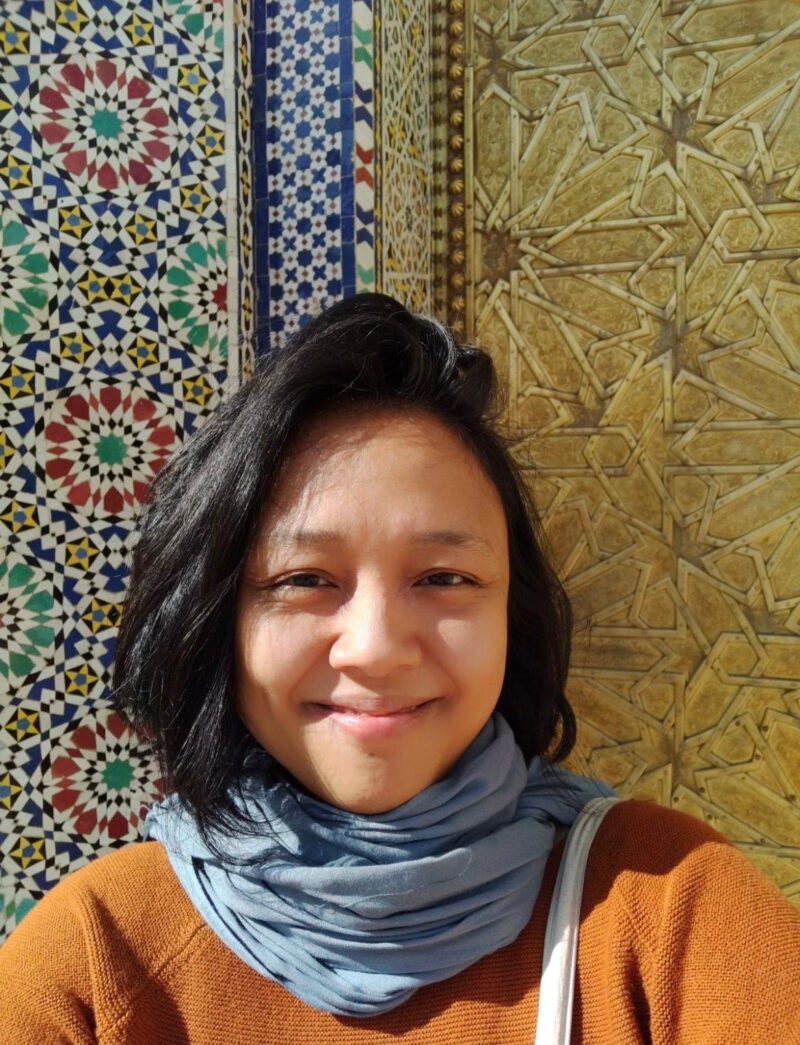
You begin the first three sections of “Tango India” by using the NATO phonetic alphabet to spell your name. How did you decide on this structure?
It happened rather organically. I started writing down my name, Titi, but realized that for many, “titi” is nothing more than a repetition of two identical syllables—it’s unfamiliar outside its original context, often not even perceived as a name. So rather than pushing to explain, I decided to bypass the name altogether and focus on the two sides: the original intention of the name, against how it—de facto—lives within the systems, which led me to the NATO phonetic alphabet. The structure emerged from that tension: trying to make a name legible while gradually reclaiming its meaning.
You craft some masterfully unconventional scenes. For instance, the third section, there’s dialogue, but no context of speaker or setting. Why do you think this worked so well for this piece?
Perhaps it’s the associative nature of the story. Earlier on, I established that ‘we live in a language without tenses,’ and throughout the piece I deliberately let context emerge through association rather than a linear chronology.
The interchange in the third section carries the same weight as the rest of the story and is written in a similar style: matter-of-fact yet layered. Perhaps that gives readers enough threads to place the voices within the larger story. Glad it worked out.
The antagonist here is a nameless “they,” and I’m torn if I should interpret the “they” as the same persona throughout the piece, or if “they” shifts into different characters because I think it works either way. Could you clear this up for me?
The “they” mirrors the sporadic way these encounters happen in lived experience. It shifts: Sometimes it’s a genuine misunderstanding or unawareness, though at times it represents something bigger—an institution, a system of knowledge or a structure that dictates even the most intimate aspects of life, such as who you are or how your identity should be formatted. It’s not necessarily antagonistic, although I often find myself in disagreement with it, or indecipherable to it.
After reading your bio, I have a hunch you’re a polyglot. Am I right? How do you think knowing different languages has influenced you as a writer?
I’ve been lucky enough to learn and be familiar with several languages, which has helped me interrogate words and sounds more intimately. For this story, I think the influence runs deep. I’ve been taught to think about how languages construct our perceived reality, and how they shape the way we categorize time, space, or even taste. The idea of where the past ends and the present begins, for example, often feels different between languages. Why would someone stop being my father when he passed away? Am I not his daughter anymore? Am I just a daughter of a past-tensed memory?
Unlike French or Italian, where you are required to grammatically position an event in time and indicate how it unfolded in order to choose the appropriate tense, in Indonesian, time is often established through context; We don’t grammatically inflect verbs for tense.
This story is, in many ways, a negotiation between these linguistic realities and how they shape memory: a Latin thread, a Javanese conception of names, and the mundane NATO alphabet.
What does red ashoka look like? Does it always bloom during your birth month in November?
Ashoka looks like red pom-poms crowded against a dark green shrub. Up close, you’d see that each pom-pom is actually a cluster of needle-thin florets with star-shaped petals. I don’t remember seeing it throughout the year, but I remember the smell of wet soil and raindrops on its leaves, so it must have been in the rainy season, sometime around October and November. As a child, I used to pluck a floret and suck the pedicel like a straw to taste its sweet nectar.


 In September 2022 SmokeLong launched a workshop environment/community christened SmokeLong Fitness. This acclaimed community workshop is happening right now on our dedicated workshop site. If you choose to join us, you will work in a small group of around 15-20 participants to give and receive feedback on flash narratives.