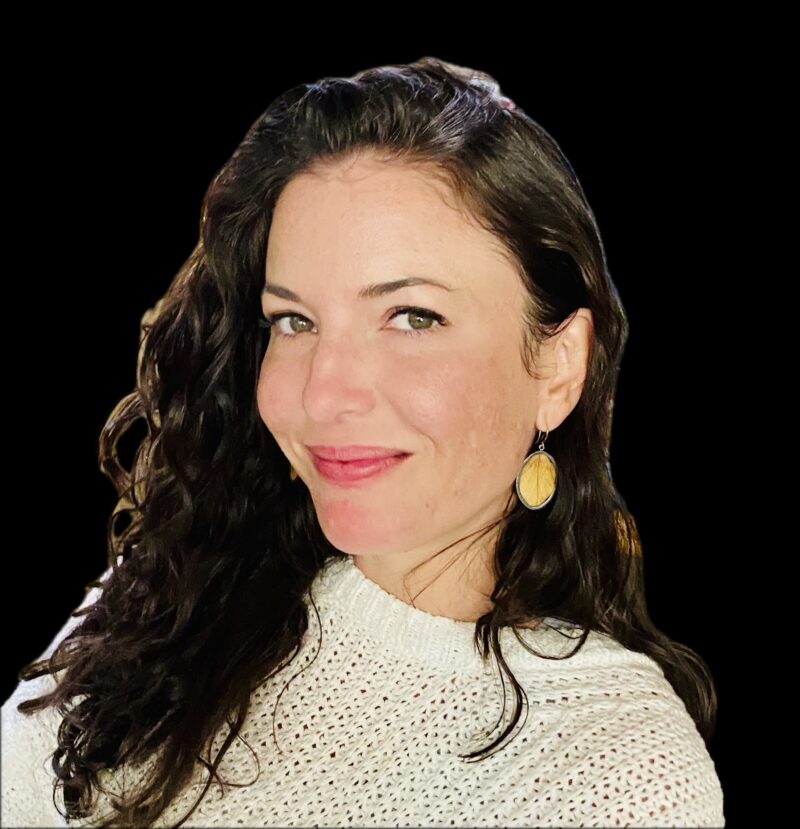
Your essay benefits from many compelling choices regarding the scope of the narrative. For instance, although the mother is the first essential character introduced, you quickly establish a dynamic wherein she is noticeably absent, as echoed in the following line: “I wonder if I’ve ever really seen my mother before.” What was the desired effect of this approach?
The speaker wonders if she’s ever really seen her mother before, not because she’s absent, but because this younger, more joyful version of her mother is out of reach, an artifact of an earlier time. That’s what I hoped to explore here: the way our previous versions (and those of our parents) follow us. The way a person can be young and old, still here and already lost. I can see how that could be a depressing prospect, but in this piece, I hope it is a joyful one.
In his poem “I Have Good News,” one of my favorite poets, Tony Hoagland, writes, “The dark ending does not cancel out / the brightness of the middle.” The aunt’s death and the mother’s aging cannot reach backward and dim this moment of joy. I wanted to put some butterfly glass over the brightness of their middle. To return both women to a time before the narrator really knew them, when they were just girls in all their crop-topped eighties glory “before men, before children, before guilt and shame and loss.” And without denying the fact of death and illness and age, to let this moment reveal something deathless.
Debbie is the primary character through which you process grief and observe what has been lost, and she seemingly serves as an inspirational figure for both the mother and the narrator. To what extent does this arrangement reflect your perspective on the events that inspired this essay?
This comes from a larger collection-in-progress about the speaker’s troubled relationships with both her mother and her aunt. Many of the pieces focus on a found object from her childhood home (like this home video), using it as a case study, a way of trying to make sense of the relationships forged there. While the collection is a love story at heart, it is also a critical one, taking an honest, sometimes unsparing look at the women who made her who she is.
This piece is my attempt to allow my speaker to see the parts of them she missed—who they were before her—even as she recognizes that this view is partial, selected, mediated. The women themselves (if such an essential self even exists) remain out of reach, oblivious to the speaker watching them, but I wanted the dance to become something like PURE reach: a little sister reaching for her big sister, the speaker reaching for her mother, language itself reaching for something like eternal life. My goal was to let that dance jump off the page a little, to allow the narrator to get swept up in it. I think of the ending as a kind of ecstasis: something bigger than the mother, the aunt, or the speaker, moving through all three of them at once, in defiance of death.
Your essay also explores the ways in which social media keeps people “alive” by largely subverting the obituary’s traditional role as life’s postscript. In what ways has this modified our handling of memories, our ability to process death?
I suppose both print obits and social media posts are curated, partial, mostly scrubbed of the grit of a life. Social media just has a way of returning these fragments to us at unexpected times. I could see how Facebook reminders could feel intrusive or even cruel, but that’s not what is happening here.
The big difference between traditional obits and social media videos is that in video form, you get to see the dead in motion. They become revenants, returning every year, ageless while you age, memento mori on your (literal and figurative) timeline. It’s easy to imagine how such ghostly reminders would be unwelcome. But here, Debbie’s ghost is more of an invitation to the party. Gather ye rosebuds, in a way.
Maybe the video’s recurrence is less important than what happens when the speaker watches it. She’s seen the video many times, but in this telling, she gets swept up by it, called into the dance, too. Maybe social media “reminders” of past posts create more opportunities for us to encounter the same memory differently as we age.
Finally, the video features Soul II Soul’s music, a band whose heyday was nearly forty years ago, which parallels the previous point. To what extent are you exploring the ways in which modern technology has “flattened” the traditional cultural arc, making some aspects of popular culture somewhat timeless?
I’m not sure I think of technology as having “flattened” the traditional cultural arc. If anything, I’m interested in the opposite: the way something that once seemed ordinary or disposable (like home videos or even the moments they capture) gathers depth and texture in retrospect. In this piece, technology is just the tool that gets the speaker there.
Soul II Soul does give the women a particular moment in time before illness and age and loss changed the way the narrator sees them. But the video’s recurrence also carries that moment forward into the speaker’s present and beyond, into the unknown, off-the-page, over-the-horizon future. I guess I was aiming for an uncanny collision between these different kinds of time.
Something timeless is happening anyway, though. Or maybe not timeless, exactly, but outside of time. Is it too hokey to call that transcendence? Maybe ‘inheritance’ is a better word—something that passes through time without being bound by it. The larger collection this piece comes from has the working title Scavengers, and a lot of it is concerned with what we inherit. Not necessarily the things our families meant to leave us but the scraps: objects, stories, images, habits, addictions, the joy and trauma and cosmic dust of their lives. What we find in the wreckage, and what we make from it. This video is one of those scraps.

 In September 2022 SmokeLong launched a workshop environment/community christened SmokeLong Fitness. This acclaimed community workshop is happening right now on our dedicated workshop site. If you choose to join us, you will work in a small group of around 15-20 participants to give and receive feedback on flash narratives.