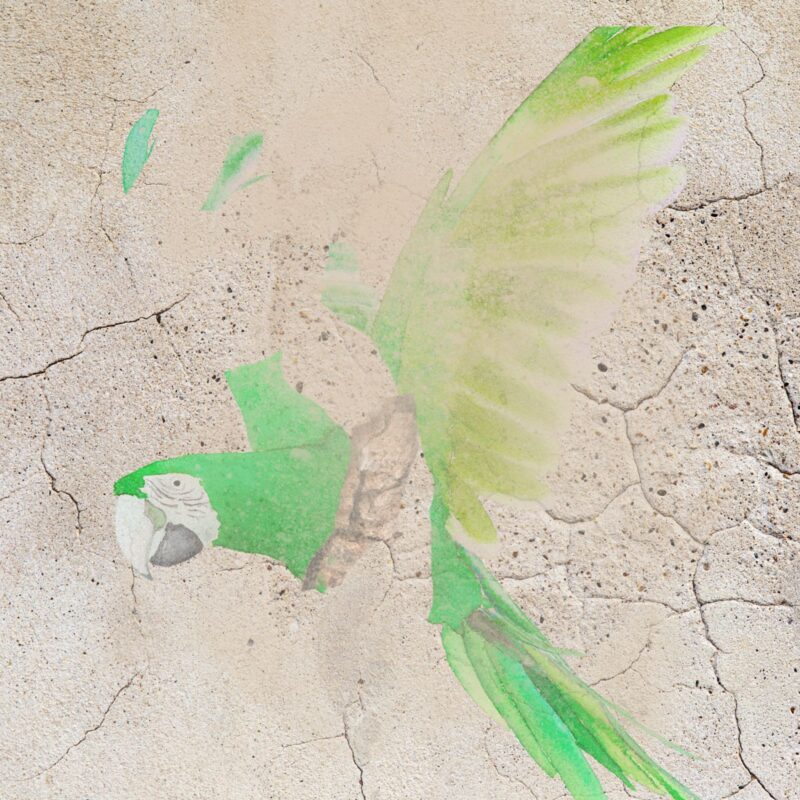
The damage begins with a parrot; not the whole bird, though. Only the tail, where a season of monsoon seepage has lifted the paint from the plaster and left a pale wound in its place. My mother discovers it the morning after Chhath and spends breakfast staring at the wall with the expression some women reserve for the faulty sarees at sale.
By noon she has dragged a stool into the Kohbar room.
The room is older than I am, older than my marriage, older than several marriages, if family stories are to be believed. Lotus flowers bloom across the walls. Bamboo rises in careful green clusters. Fish circle one another eternally. A painted sun occupies the eastern corner with the confidence of something that has never known disappointment.
My grandmother painted most of it.
The village still remembers this as one of her virtues.
It remembers other things less clearly.
I arrive carrying a small suitcase and the sort of exhaustion that makes every object appear slightly misplaced. My mother notices the suitcase immediately. She notices everything immediately. When I was thirteen she diagnosed appendicitis six hours before the doctor. When I was twenty-one she recognised heartbreak from the way I closed a gate.
She says nothing about the suitcase.
Instead she hands me a torch.
“Hold this.”
I hold it.
The beam settles across the damaged parrot.
My mother begins mixing paint.
The green arrives first, followed by black; then the thin white line that will become the edge of a feather.
Outside, somebody is selling guavas from a cart. A train horn drifts faintly across the afternoon. The neighbourhood continues its business while I search for a way to tell my mother that my husband has moved out and that the silence between us had become so complete it eventually qualified as a third person in the marriage.
The sentence refuses to leave my mouth.
My mother restores another feather.
“You know,” she says, “your grandmother hated this bird.”
I laugh. The parrot looks identical to the others.
“Why?”
“She said the beak was wrong.”
The answer feels incomplete.
Years later I will understand that nearly every answer in my family arrives incomplete.
My grandmother’s wedding photograph hangs in the next room.
She is sixteen.
The garland around her neck appears heavy enough to alter posture.
My grandfather stands beside her, handsome in the severe way old photographs reward men and punish women.
The wedding happened quickly.
This is one of the few facts everyone agrees upon.
Whenever the story approaches the reasons, it dissolves.
An uncle changes the subject.
An aunt remembers something else.
My mother suddenly needs to check on the rice.
Family history, I have learned, is not what happened.
Family history is what survives repeated attempts at forgetting.


 In September 2022 SmokeLong launched a workshop environment/community christened SmokeLong Fitness. This acclaimed community workshop is happening right now on our dedicated workshop site. If you choose to join us, you will work in a small group of around 15-20 participants to give and receive feedback on flash narratives.