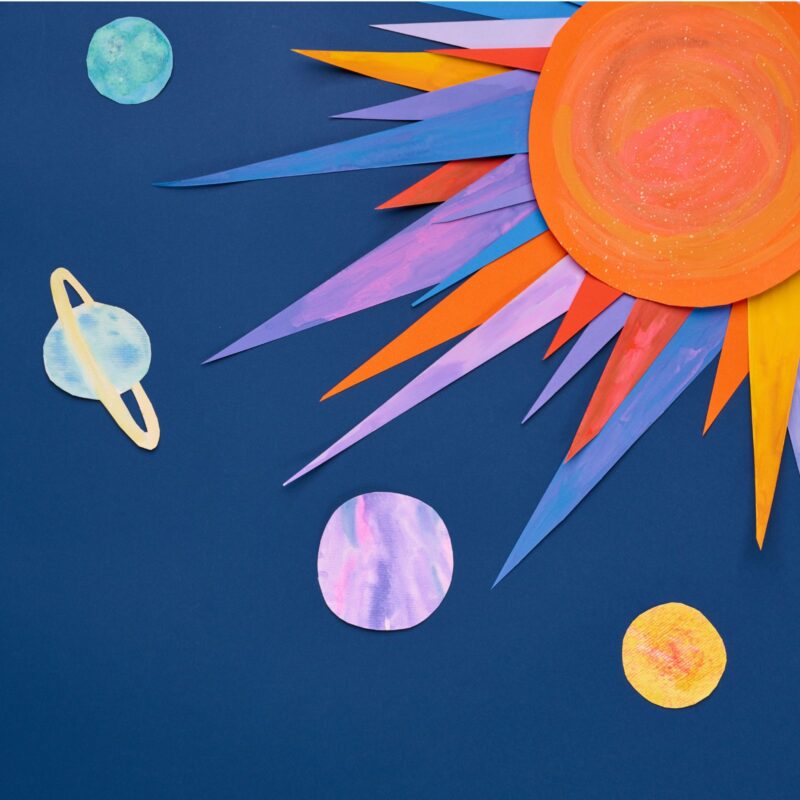
She will get to space. Before that, she eats breakfast. Decades before. Alone in the nook, thumbing the waxy nub of a crayon, the paper placemat filled by spectral graphs, notations, detailed models of the solar system. The oatmeal is cold by the time it reaches her mouth. Must she eat alone? Why not with a family? All astronauts have families, though her family is occupied by stellar evolution, by quarks and fission in this house of strict scientism. She comes from a family of stargazers, skywatchers, frequent fliers. They hail from The Birthplace of Aviation Pioneers, also known as Ohio, and the astronaut is raised on hard facts, math, and the metric system. Her parents might ask, What is the average surface tension of America’s most nutritious breakfast? But when the astronaut eats breakfast alone and cold, her parents are jettisoned from view and orbiting her mind like vague satellites.
And what’s lonelier than a planet? Everything that’s not a planet. Distance and force. Cold, alone, oatmeal.
There are other breakfasts, too. Later breakfast, outside the atmosphere of childhood, meals arranged on porcelain with juice and toast and protein powder. In a different nook or a bistro table, though much like all the other breakfasts, held by the same forces: gravity, electromagnetism, nuclear fission. Perhaps she is with a family, a husband and children, a wife and child, a dog and a cat. The kind of family that can fit on a whiteboard. There’s one, blocking the kitchen window, freestanding on rolling castors. See stick figures drawn in felt-tip marker, ghastly in their blankness, the cat and the husband and the potential children watching a rocket containing their mother escape the atmosphere, just a few wavy lines to render the barrier between heaven and earth. And next to the stick figures, equations sketched with a sharp and certain hand. The astronaut’s calculations, large enough to eclipse the family. Of course, she must eat alone, occupied by sudden developments in the realm of aerospace, by her ventures into weightlessness, by her training in Space City, also known as Houston. It’s not quite the astronaut’s fault, bound as she has been to the stars since her parents spun a mobile of constellations above her crib.
Most astronauts have a family before they leave the planet. Some after. None during. The laws of family do not extend across the universe. Families are strictly terrestrial, concerned more with the astronauts’ return than with their voyage. Families of Penelopes and Telemachuses. The question becomes, why bother with breakfast? Why not skip the ritual, gorge on freeze-dried meals, and leave the family with the rest of the earthlings—miniaturized, arrested on the pale-blue dot. Is she even hungry?
But still, as a child in the nook, oatmeal is a fact, and a most expected breakfast for an astronaut because of its wholesome American ubiquity. We’re not talking about cosmonauts here—a whole different breed. A whole different breakfast.
Why not leave the family altogether? There’s no room for them in the spacecraft. Dogs don’t fare well in space. For husbands and wives and children, it’s even worse.
See the oatmeal dribble from a silver spoon. Globular, the color of sawdust. Does it hang there in your mind without gravity? Does it deny the Earth’s rotation? It can’t quite yet. We must lasso our lone astronaut, slow the speed of light. We must avoid placing her amongst the stars too early. A kitchen, a table, a window (open), a bowl into which the astronaut is staring—now and before. Her entire life a waiting room for the great beyond. Terrible to imagine her frowning at breakfast, but there she is, doing it, dim-eyed and phlegmy too, with the spring air coming in, a few tracers of dandelion fluff balancing on the counter. Drafty, but it doesn’t bother her, gooseflesh in the morning. No bother at all.
Later, three hundred miles above Earth. The cold is flat and breathless. Through her suit, her skin doesn’t even seem to notice it. Long after breakfast, she sees the sun from the vantage of space, through a gold polycarbonate visor. She is not blinded by light, nor stupefied by thermal radiation, nor crushed by cosmic fear. But she will think, for the first time in her life: One day this will be a red giant. Five billion years is less than one year per person living on Earth. More people than years. She looks down at Earth and waves to her children. They’re waving back.
The rings of Saturn, Galileo thought, were minor planets—children orbiting their father. How very wrong, not only from a cosmological perspective, but, in a vague anticipation of Freud, he’d read the entirety of his unconscious wrong. We are all the children of astronauts—the astronaut knows this—seeded from space. Every human being’s life is complete only once they’ve left the planet. Ptolemy, right all along. The Heliocentric revolution, that scandal, recognized our position, but not its cause, not its meaning. Kepler and Newton fell asleep. Astronauts are made idols on cereal boxes, but every breakfast is a failed launch. The husbands and wives block the view of the sky.
She stops waving and turns away from the planet, glimpses the darkest corner of the galaxy, then closes her eyes. Finally, alone, she floats.

 In September 2022 SmokeLong launched a workshop environment/community christened SmokeLong Fitness. This acclaimed community workshop is happening right now on our dedicated workshop site. If you choose to join us, you will work in a small group of around 15-20 participants to give and receive feedback on flash narratives.