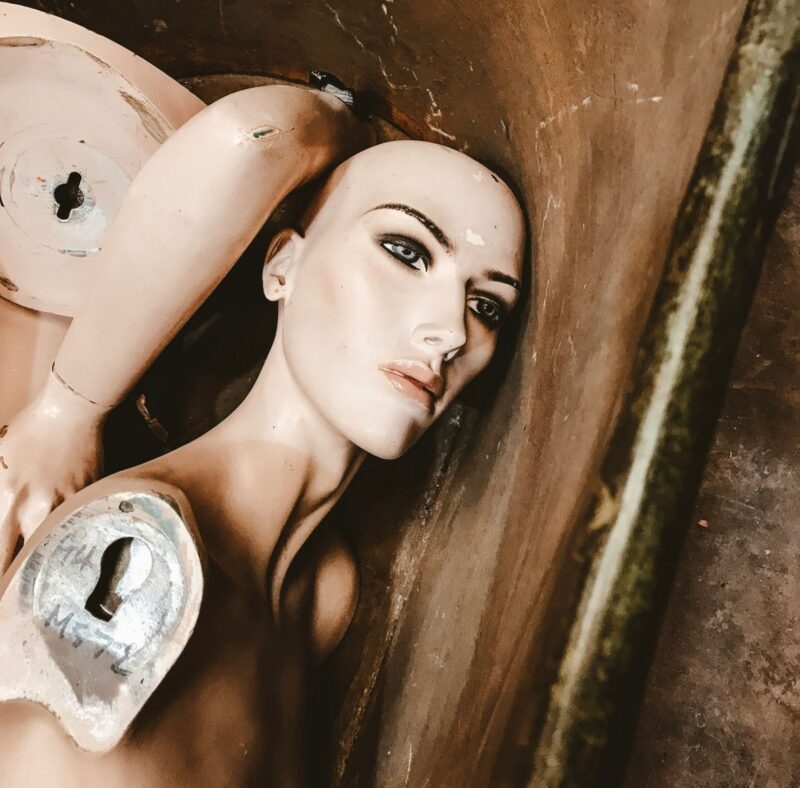
The easiest way to get a shirt on a mannequin is to remove its arms. A little twist and they snap off, although sometimes at Ultera we’d really have to yank on them, leaving gray fingerprints we’d scrub away with a Mr. Clean Magic Eraser. My mom told me in the olden days they swaddled babies in dozens of layers, tight until they looked like little mummies with bonnets. They thought their bones were brittle like twigs.
When I got pregnant, I was working at Ultera. I wasn’t a very good salesperson. I never got anyone to sign up for the credit card.
“Did you get the message that Chloe called? The cropped cashmere sweaters?” Sarah whispered, so close I could smell the coffee on her breath. “The man. Looks like a hippie?” I stopped scrubbing and handed her the Magic Eraser. She let it hang between her thumb and forefinger like a dirty sock. I was pretty good at cleaning mannequins. I was pretty good at trailing Chloes.
Chloe was our code for potential shoplifter. When Chloe called, we were supposed to stop our task and move to the affected area. There was some racial profiling. The hippie was white, but it was rare to see a man in the store alone. Anything rare was suspicious.
I had never stolen anything from Ultera, but I knew people who had. I went to at least one meeting a week with folks who stole boring clothes from stores like Ultera. Others stole money. A lot of people stole drugs. Electronics were big. So was jewelry. I preferred shoes, sturdy, expensive ones, and ever since I was a kid, I’d been stealing food, even though we didn’t always need it. I was trying to quit. Right before I started working at the mall, I’d cracked open a fortune cookie I snatched from someone’s to-go bag on the bus. The cookie advised me to do something meaningful with my life. Working retail without stealing from my employer wasn’t meaningful in the traditional sense, but it made me feel like I was living on the edge, which is meaningful for an addict.
I approached the hippie. Arlo. I only learned his name later, after the store had closed.
He really wasn’t a hippie at all, just a man dressed like someone a person too young to have known actual hippies would imagine them to look: long hair, an unbuttoned flannel over a T-shirt so faded I couldn’t even read it. He was holding the sleeve of a melon-colored sweater and delicately stroking it, like someone might do with a small animal. Arlo was not actually very gentle, so this memory always makes me wonder if I’d imagined it. The frayed ends of Arlo’s corduroys dragged on the floor as he moved to a section of cardigans. He touched all of them.
“Can I help you find something?” I stepped closer. He dropped a sleeve. He rocked back and forth on the soles of a pair of brown boots, which were actually kind of nice. “Are you looking for something in particular?”
He smiled. “What’s your name?”
“Connie.” I was stupid, but not stupid enough to give him my real name.
“Connie.” He turned back to the sweaters. “You got a lot of headless women in here. Porcelain? Or maybe fiberglass?”
“What?” I could see Sarah watching as she unfolded and refolded a pile of silk tanks. A hippie touching merchandise was not good for business. Sarah’s anxiety about low conversion rates was already through the freaking roof.
“Fiberglass, probably.” He pulled a cardigan off its wooden hanger and held it up to himself. It fell just past his chest. The tips of his hair brushed the cashmere. “These sweaters are real short. What’s that about?”
“They’re cropped. It’s the style.” I took the cardigan and brushed it down before rehanging it. “Are you looking for a gift?”
“A gift. Yes. For my daughter.” I learned later that he hadn’t spoken to his daughter in years. He couldn’t even remember how old she was, but he guessed that she was around my age. “What do you think about these mannequins, Connie? I saw you washing them before.”
“Well, they’re heavy as shit. Sorry. They’re heavy. And they can’t dress themselves.”
“Well, neither can I.” He laughed. “I’m an artist. No one cares what I wear.”
“You’re an artist?”
“I am.”
“So, what color does your daughter like?”
“This cantaloupe is nice.” He held it up to me, resting the hanger on my shoulders. “Do you know how much one of these girls costs? On the internet?”
“Do I know how much a mannequin costs? No. A lot?” I took a step back. “Do you know what size your daughter wears?”
“Hundreds. If you want a nice one, that is.”
“I never thought about the mannequins.”
“So, Connie,” he said, taking a baby blue cardigan down from the ballet bar. “I’ll buy this one. And, you know.”
“What?”
“You look like you could use some extra cash. You can help me with my art, I think.”
I could see Sarah looking at us, so I took the sweater from him. “I’ll ring this up for you,” I said loud enough for her to hear.
Sarah smiled. I had made a sale.
Arlo and I managed to steal a mannequin that night, one of the dingier ones in storage. He watched me clean it. He started painting. I tried on his nice boots. He held my wrist until I thought it might snap off. He let me keep the blue cardigan. I waited a few weeks to wear it to work. The sleeves weren’t long enough to hide the bruises, which were purple and then sort of green and then finally a very faint yellow that slowly, over time, almost completely disappeared.

 In September 2022 SmokeLong launched a workshop environment/community christened SmokeLong Fitness. This acclaimed community workshop is happening right now on our dedicated workshop site. If you choose to join us, you will work in a small group of around 15-20 participants to give and receive feedback on flash narratives.