“Girls,” the doctor says, “we believe that you have consumed something strange.”
The doctor wears a long white coat and when she raises her arm to check our vitals, we can see that she wears a pink shirt, her armpits ringed with sweat. This is good, we want to tell her, perhaps you know the truth.
“So, what have you eaten?” she asks us. “Anything out of the ordinary?”
We are not frequent visitors to the hospital. We know women who track the mottling of their skin, the lumped milk of their flesh. But we do not take our comfort from their tubes and tests, the relentlessness of categorisation. Still, we will answer her questions.
We tell her that we start every day with a grapefruit, that we use a silver spoon and we place the grapefruit in a jade green bowl and we sit in our garden and portion out the pips with our fingers.
“You do not live on a single grapefruit girls,” she says derisively.
“It’s important to live off the land.”
She raises her eyebrows, “Did you eat something off your land then?”
Not our, the, we try to say. Hasn’t she ever taken a grammar lesson with all her doctorly training? Doesn’t she know the political stakes of a possessive?
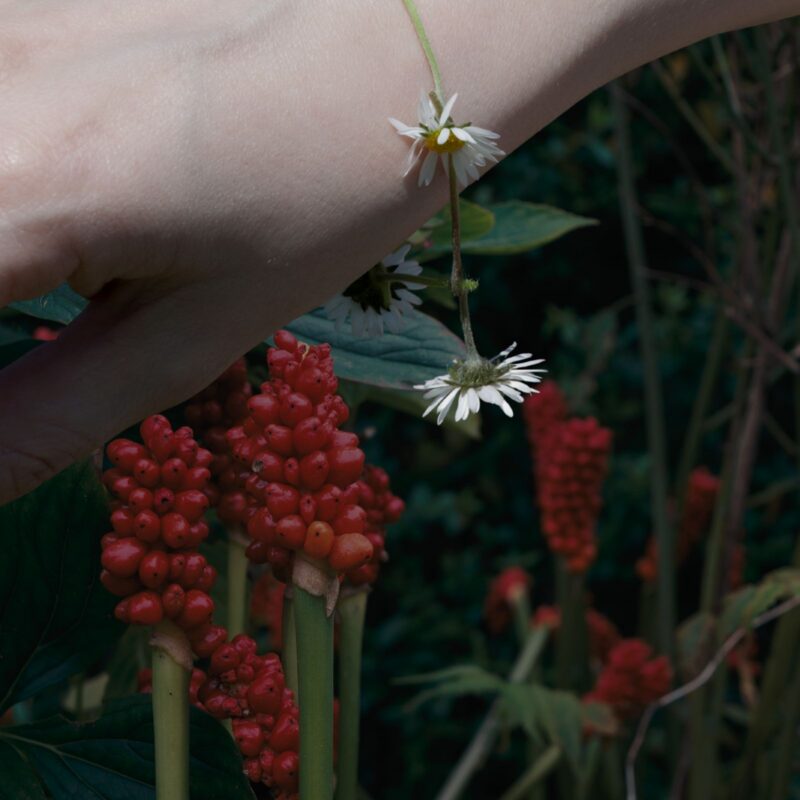
We tell her that we were raised in the country. We tell her that we were raised with the slitted stems of daisies wound round our wrists, that we sucked honey from snapped fuchsia heads, that we wrapped red welts in rough dock leaves. We understand from our own English lessons the importance of sowing a story.
The doctor pulls a chair over to our bed with one hand and sits down. We are impressed by the way her wrist swivels.
“Girls,” she says, “This is serious. If you don’t tell me what you’ve eaten, it could take a very long time to find out and by that point.. well, the effects could be much more severe.”
We imagine that this doctor has a husband with slicked back hair and a panting mouth. We suspect that the doctor learnt to portion out her breaths with him.
“Patience is a virtue,” we say.
The doctor runs her tongue across her front teeth. We watch her cheeks bulge and wonder whether she’s ever felt a foetus grow inside her. We ask her to tell us what she believes in.
“I believe in getting you better,” she says, placing two fingers on our waxy wrists.
“That is not a belief system,” we explain. “A belief system is something you can stand on and look up to at the same time. It’s formative and germinative simultaneously.”
The doctor says, “Please girls. I have other patients.”
“Fair enough,” we shrug.
Some things are better kept sacred.
“What about a trade?” she asks, “I’ll tell you what I believe in and you tell me what you ate.”
We consider the stakes.
“Alright,” we say.
“Once,” the doctor says, “I hit a rabbit with my car. It came out of nowhere and I slammed on the brakes but I hit it. And I could tell that it was likely going to die. I could either take it to the vet and watch them euthanise it or I could just deal with it myself. One quick stomp and done.”
She stares at a speck of our vomit on the floor as she speaks. We have always been intrigued by those whose beliefs are borne from happenstance. Who are led by action and then determine the theory to fit.
“Mercy,” she says, “yes, but also efficiency.”
We had assumed she would be a practical woman. This is hardly a surprise, but we can tell she feels like she’s revealed something precious and damp. We would show her where the tadpoles spawn in our pond if we could. Instead, we offer up our belief system. We may be lapsed Catholics but we still believe in an eye for an eye.
We tell her, “There is too much emphasis on innovation. People are led by impulse only. Where is the root system?”
She asks if she can call someone for us.
“Please girls” she says, “I really do want to help you.”
We have not seen this desperation in her before. We look at her sweating armpits, the small pinched bud of her mouth. We start to tell her that this was a misunderstanding. We are fine. We did not mean to make her worry.
“I am not worried girls,” she says, “I am a healthcare professional. It is my duty to treat you.”
It will be hard to explain this to her. She was reared in sterility where there are only blue gloves and consequences.
We tell her, “In the forests where we’re from, grow lord and ladies. Bulbous stems with red fruit. The girls we went to school with used to say you could get pregnant just by touching one. Then they would rub their hands up and down the stem until the seeds split.”
She cocks her head to the side. We think of the sunken skull of her rabbit and remember there may be hope for her yet.
We understand that she believes she is saving us, we tell her. Two people can have the same intentions but a different goal, we know this.
“Girls,” she says sharply, “was this self-inflicted? Is this your cry for help?”
None of the girls ever got pregnant just by touch. We are adult women anyway, we know that procreation is not a game of tag. Instead, we wondered about the sap that burst from the berries. We have slept with men, enough. We know that milky sap is where the babies lie.
We didn’t want to go to the hospital. But our mother found us lying on the bathroom floor and insisted.
“We are pregnant,” we say, “Born of the forest.”
______________________
“Fruit of Our Body” is the second-place winner of The SmokeLong Quarterly Award for Flash Fiction 2026.

 In September 2022 SmokeLong launched a workshop environment/community christened SmokeLong Fitness. This acclaimed community workshop is happening right now on our dedicated workshop site. If you choose to join us, you will work in a small group of around 15-20 participants to give and receive feedback on flash narratives.