Reviewed by A. W. Earl
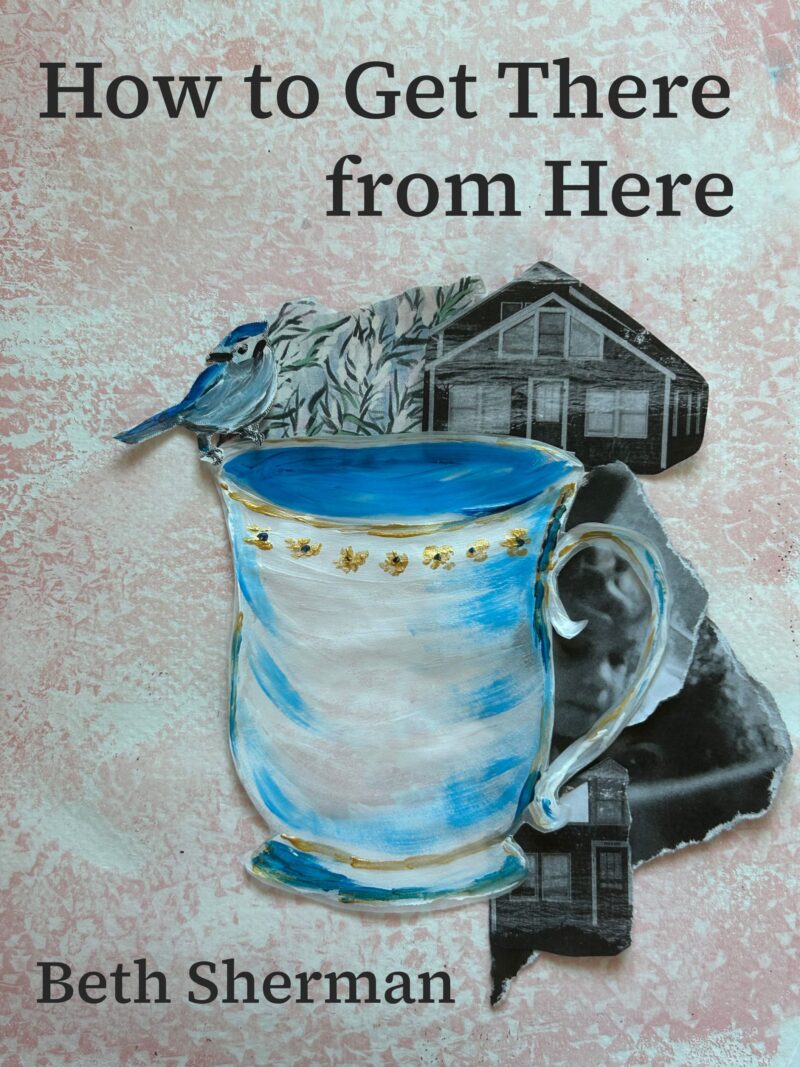
Beth Sherman’s How to Get to There from Here is a flash fiction novella which explores the shifting nature of care, responsibility, and intimacy between Sylvia – a woman with Alzheimer’s disease – and her daughter Lauren. Using Sylvia’s illness as a framework, it explores the very nature of memory: its loss and rediscovery, its recontextualization, and how it might be communicated, both to the self and to others.
A novella which feels like a battle of wills, the first and third parts are from Lauren’s perspective, with the central section from Sylvia’s. It opens and focuses upon Sylvia’s flight from Lauren’s house, and each ‘chapter’ or ‘piece’ adds detail to the whole, providing us with a fuller image of the progression of Sylvia’s illness, her rejection of Lauren’s care, her “escape” – both literal and back into the certainties of her own childhood – and finally, her relocation to a care home.
At times a claustrophobic read, Sherman chronicles with great care the unsettling reversals and defamiliarizations of dementia. Both protagonists feel imprisoned by Sylvia’s sickness – unable to get their lives back from an illness which threatens not only to devour them both, but to destroy their connection to each other, “like scuba-diving with a faulty oxygen tank.”
A focused work of loneliness and desperation, Sherman invites the reader to inhabit two states of imprisoning despair, showing how Alzheimer’s un-persons the carer as much as the sufferer. Lauren struggles through impossible situations, while denied relationships, sympathy, and work, while Sylvia is desperate and bereft – her frantic attempts to recapture a language which evades her create a narrative which is intense and panicked.
However, neither protagonist passively accepts this state – through a repeated motif of “Lists,” both Sylvia and Lauren attempt to reimpose order on their world. Through the increasing repetition, incoherence, and futility of these lists, Sherman lets us see how that resistance is broken down. By the third part, Lauren’s desperate and dynamic “How to Stop Your Mother from Wandering” lists have been reduced to a more passive form of recording – listing the carers her mother has alienated, and finally, simply journalling.
Yet, it is in this surrender of struggle – both textual and personal – that a certain peace is to be found. As Lauren accepts the inevitable, she is no longer trapped by the past and can grieve its loss without being overwhelmed by it. Sherman reframes Sylvia’s childishness, which was previously framed as incapacity, into a facility for wonder and joy in the face of loss: “There’s us at the beach last summer. We stayed so near the waves we kept having to move our chairs back as the tide rushed in. Each time, she squealed with delight like a child discovering her first sunrise.”
This imagery of sea, tide, and beaches recurs throughout the work, occupying many functions from an idealised past, a notion of escape, a metaphor for the nature of memory and memory-loss itself. Both at a structural and an emotional level, its use provides a throughline of the narrative, and even a broad parallel for Sylvia’s declining health, as its invocation moves from single, distinct memories, to conceptualised ideals, until it is finally captured in the concrete, but frozen, medium of the photograph.
Motherhood is at the heart of How to Get to There from Here, especially its relation to the act of care. Sherman repeatedly draws out attention to the way in which elder care inverts the traditional parental relationship, replacing the camaraderie of the adult parent-child relationship with the grieving caregiver struggling with a recalcitrant and infantilised parent.
Indeed, Sherman presents both Lauren and Sylvia situations as resisting adulthood. Lauren is trapped in the perpetual precarity of pre-adulthood, her burden of care ironically curtailing her independence, reducing her life to insecure and unfulfilling jobs, to mess, and failed relationships. Meanwhile Sylvia’s distress and confusion often present themselves through the language of childhood play or conflict; from the burying and exhuming of “treasure” (both literal and metaphorical), to a heedless “running away from home” – an act which specifically echoes an event in Lauren’s childhood.
Faced with this tension between their own infantilisation, and their grief around it, both Lauren and Sylvia express a desire to have their mother “back,” as if a re-establishment of the “correct” maternal figure could offer them both relief. While this is moving and does much to convey the vulnerability of both protagonists, it arguably misses an opportunity for insight about the social condition of motherhood itself.
While we are offered detail of the emotional conflict in Lauren’s caregiving – which is resentful, and distressed – the state of “natural” motherhood is primarily viewed from the child’s perspective, in which the mother is not only endlessly patient and benevolent, but also exempt from social criticism. Even from Sylvia’s perspective, motherhood itself is not located as a site of overwhelm, shame, violence, or despair – and I feel that engaging with this aspect would have served to strengthen both the narrative and the parallels it draws.
One of the most ambitious aspects of the text is Sherman’s use of both the possibilities of flash and the opportunities of longer form prose, to convey loss of language through linguistic means, and loss of memory through repeated images. The individual, stylistically distinct sections of flash fiction allow Sherman to use a number of experimental techniques to do this – such as the use of strikethrough in “What happened to the dog?” – without requiring her to abide by that decision for the whole text. Similarly, as with the protagonists’ use of lists, the novella form allows these experiments to recur – both increasing their effectiveness, and emulating the cyclical, repetitive nature of Alzheimer’s itself.
Overall, How to Get to There from Here is an interesting read, with convincing characters and much to say about grief, memory, and the mother-daughter bond. While formally interesting, and experimental in places, it remains pacey throughout and never overburdens the narrative with needless complexity.
How to Get to There from Here is available now in paperback from Ad Hoc Fiction.
Also look for Bring Me Home a Sloth (Alien Buddha Press) out now.
_______________________________
 A. W. Earl is a non-binary writer, storyteller, and poet based in the Scottish Borders who works primarily in poetry and long-form prose. They studied Literature with Creative Writing at the University of East Anglia and have been performing as a poet and storyteller since their mid-teens. Among other venues, their work has appeared in collections by Renard Press, Watkins Press, and Queer Words Scotland, and has been featured by the International Human Rights Arts Movement, and Full House Literary. Their debut novel Time’s Fool was published by Unbound in 2018 under the name Alys Earl.

 In September 2022 SmokeLong launched a workshop environment/community christened SmokeLong Fitness. This acclaimed community workshop is happening right now on our dedicated workshop site. If you choose to join us, you will work in a small group of around 15-20 participants to give and receive feedback on flash narratives.