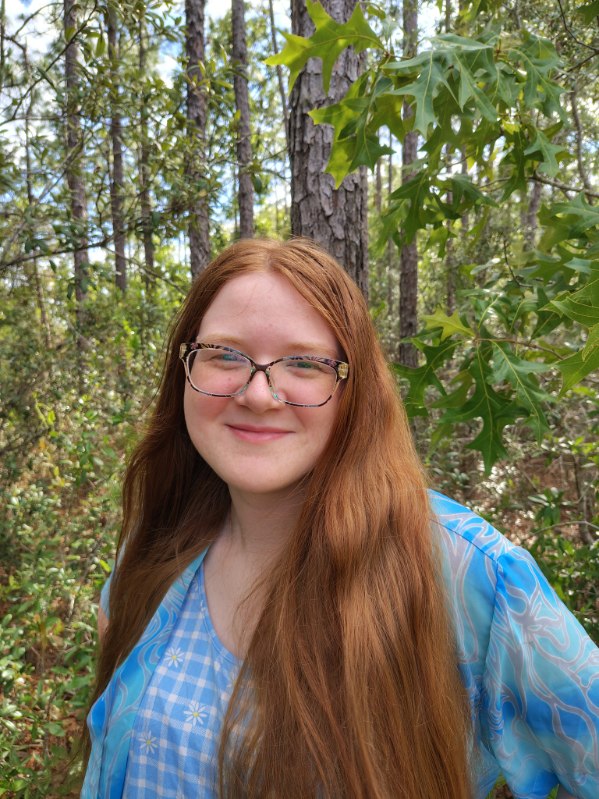
I haven’t listened to Cuban frogs but have experienced Puerto Rican coqui frogs. It’s such a symphony of sounds. Eerie. Community. Seasons. Rhythmic. There’s a similar lyricism throughout your piece. Your own song. Own storm. Being devoured by a bigger frog. How did you choose this setting? This messaging? The specific timing?
The story is set in central Florida, where I grew up, because I figured if I wanted my work to punch hard, I’d better make it personal. Extending from that, I tried to make the timing of the piece resemble how it feels to get stuck in your own head: we’re in the present, then we’re thinking back on how we got here, then we’re in the present again, then suddenly it’s ten years ago, and for just a brief moment, we’re a little kid again, then back to the present, and the moment is over. Devoured by a frog, devoured by hopelessness, devoured by your own memory. A storm indeed.
SmokeLong Quarterly publishes narratives without specifying fiction/non-fiction. Is there a real-life experience behind the story?
The story itself is fictional, but it’s absolutely stacked with real-life experiences. Stepping outside after a hurricane with my mom, really early in the morning when it was still pitch black out, just to have a look around. Noticing that the frogs stop singing when we point the flashlight at them and start back up again when we turn it off. Being a little kid absolutely delighted to see the house covered in tiny treefrogs, and those frogs disappearing more and more every year. I grew up in a house surrounded by longleaf pines on all sides, and over the years they’ve been cutting them down to put up more houses. There’s far from just one left, thank goodness, but it scares me. This story is basically my worst-case scenario.
I love how the opening and closing of this story both mention the flashlight—off and on—but also you include light/darkness contrasts through the piece. The black outside, beam of the flashlight, sparkling yard, pitch black, dark night, dirty water, the lightness of the frog songs against the darkness, the tiny reflective eyes, black tree silhouettes, you being outside alone while your family is inside, the frogs having a community outside, the stand of trees, even the marked Xs in contrast. Beyond the mentions of the flashlight literally being off and on, you do such a wonderful job at illuminating/turning off the light throughout. The repetition of those contrasts helps drive the quieter and more internal storyline here. Was that a conscious choice?
I love using contrast/juxtaposition. Placing something against its opposite is striking, dramatic, it draws your attention to the subject and the empty space around it, be it consciously or subconsciously. That’s what I was pulling from with the use of light and dark in this piece; I wanted to evoke the same emotions in the reader that I feel every time I see a black treeline against a saturated sky.
We get a wonderful story opening with the frog sounds and then, at the story’s end—the frogs stop singing, the trees stop rustling. More contrast. I’ve always found it difficult to include strong sensory details in writing, and you not only do that, you assign more meaning to the silences/singing contrasts. Do the frogs “see” you and your flashlight as another possible intruder?
The frogs are as afraid of me as I am of them. They’re watching me, I’m watching them, and we both see a threat. They think I’m a predator. I know they’re a threat to the ecosystem. A problem that’s gotten so far out of control, no one person could possibly fix it, but that doesn’t stop me from wishing I could.
I find that the use of sound in writing is a good way to convey a sense of feeling overwhelmed. Layering sounds on top of each other feels busy, loud, like some omnipresent thing you can’t escape from. Then, when you cut that sound off, it’s like when you become so bombarded with emotion that your brain shutters and you stop feeling anything. It’s juxtaposition, again. Sound is the driving force of the story, I think. The weight of the world is crashing down on our dear narrator, until it all becomes too much and the singing stops.
Are there metaphors running parallel to this story? Climate-fiction-meets-“they paved paradise, put up a parking lot”-level destruction of natural habitats? Your own feeling of being the little frog swallowed up by a big one?
Absolutely. Human helplessness and the fragility of the environment go hand in hand, I think. The forests are coming crashing down, the little frogs are losing to the bigger ones, and somewhere in the middle, a human is being confronted with the fact that everything is getting worse, and so long as they stand alone, they are powerless to stop it.
What are you working on? What’s next? Where can we find you and your writing?
Here’s a fun answer: I don’t know!
I’ve been writing my whole life, ever since I was a little kid scribbling stories on sheets of printer paper, but this is the first time I’ve ever muscled up the courage to get my work published. I’m not sure where I’ll go from here, but I do know I’m going. I have an oft-neglected Instagram account, @lasyeah. When I put my work out into the world again, I’ll post about it there.

 In September 2022 SmokeLong launched a workshop environment/community christened SmokeLong Fitness. This acclaimed community workshop is happening right now on our dedicated workshop site. If you choose to join us, you will work in a small group of around 15-20 participants to give and receive feedback on flash narratives.