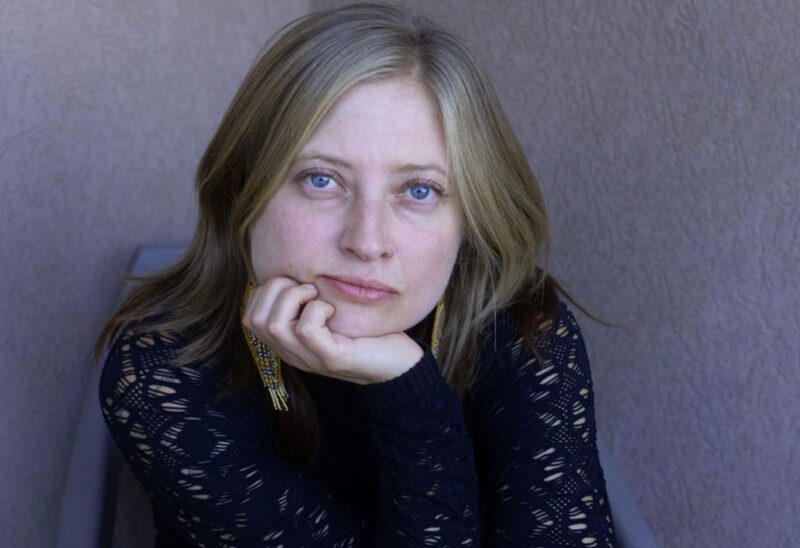
In this piece you’re accompanied by your mother. Do you think it would have been a much different interaction if you were there with a man instead?
The optics of the piece might have looked different from the outside, but the truth about me in the peak of my eating disorder: I was completely self-absorbed. I had no room to think through anyone else’s opinions of me, whatever their gender. So, really, be it some man or my mother outside the door, it would have been exactly the same: I was really very alone in that dressing room. Eating disorders are, at their core, utterly isolating.
Your mother attempts to reassure you but in the process emphasizes physical beauty again. If the antidote to body dysmorphia isn’t compliments, is it body positivity or emphasis on other attributes or something else?
If only I could answer this question. I don’t think eating disorders come from the outside as much as they come from the inside. Or at least mine doesn’t. I want to blame society for the unrealistic expectations that are imposed on the female body (and other bodies, too), but it isn’t really about that. It isn’t necessarily about the overemphasis on physical beauty, either. For me, it was and is about control. When my disorder was most acute, I was most out of control in the rest of my life. I was out of school for the first time in almost two decades. I had no idea what or who I wanted to be. I was manic, I was impulsive, I was promiscuous. My disorder was my one sanctuary, the one place I thought I could be in control, where I felt powerful. So really, unfortunately, I think eating disorders are less the result of a damaging beauty standard and more insidiously and deeply rooted in systems of power and control. The beauty standard, then, is yet another symptom of the problem and not the problem itself.
This piece perfectly describes the damage of societal expectations that women become “tiny.” How much do you think this is linked to societal expectations that women also diminish their presence and tone and volume and vocation?
There is absolutely a link here. The world at large wants us to fold ourselves into little lace boxes.
I’ll say this too: My therapist once asked me why I starved myself, why I purged after I ate only five almonds. She said, “Why did you do it?” And I had a good, long analytical answer for her that started with America and ended with capitalism. She said, simply, “No, Allie, you did it because it worked.” She meant that I did it to survive. From the outside, I imagine forcing oneself to vomit up almonds looks like the antithesis of survival. But my therapist was right, from the inside, it was about getting through the days.
Along those same lines, is sharing this story more cathartic or feminist for you, or a combination of both?
Yes, I find writing creative nonfiction to be cathartic. Writing in general fuels me, makes me feel whole. However, CNF, in particular, allows me to externalize memories and look at them from different angles. It helps me to let go of them, so they don’t have to keep swirling on repeat in my brain. As far as being a feminist goes, I try not to get wrapped up in being one on the page. I am a feminist. And yet, I resist the impulse to make myself seem good or always aligned with my belief system in my writing. That’s just not real or human or even very interesting.
Your friends confront you in what is described as an intervention, and this immediately brought addiction to mind for me. Do you think a person can use dieting to address their need to become smaller the same way another person would use substances to satisfy an addiction?
In my experience, an eating disorder, is an addiction. But I’m also an alcoholic so my tendency is toward addiction. The expression “satisfy an addiction” is interesting because an addiction is never satisfied. That’s maybe the point. It’s almost like a compulsion to repeat. And there’s familiarity and comfort in the repetition. And again, weirdly, there’s control. When I was not eating and purging, I thought I was in so much control. For maybe the first time in my life, I thought I held the reigns of this one specific thing. Same with drinking. At the peak of my eating disorder, I’m sure most of the calories I consumed came from whiskey. And I drink because I feel like I can finally, for a moment, turn my brain off. I can control it. All of this is bullshit. The more I threw up, the more I drank, the more out of control I really was.
Here’s another take on it. I read some version of this in a book about eating disorders: Eating in the Light of the Moon by Anita Johnston. A metaphor. You’re drowning in a fast-moving river and you see a log. You hold onto that log and you can breathe again. But both you and the log are headed for a waterfall. You have to let go in order to swim to shore, in order to save yourself. But how do you let go of the thing that’s saving you now? How do you trust that abandoning what’s helping you survive is the way to actually survive?

 In September 2022 SmokeLong launched a workshop environment/community christened SmokeLong Fitness. This acclaimed community workshop is happening right now on our dedicated workshop site. If you choose to join us, you will work in a small group of around 15-20 participants to give and receive feedback on flash narratives.