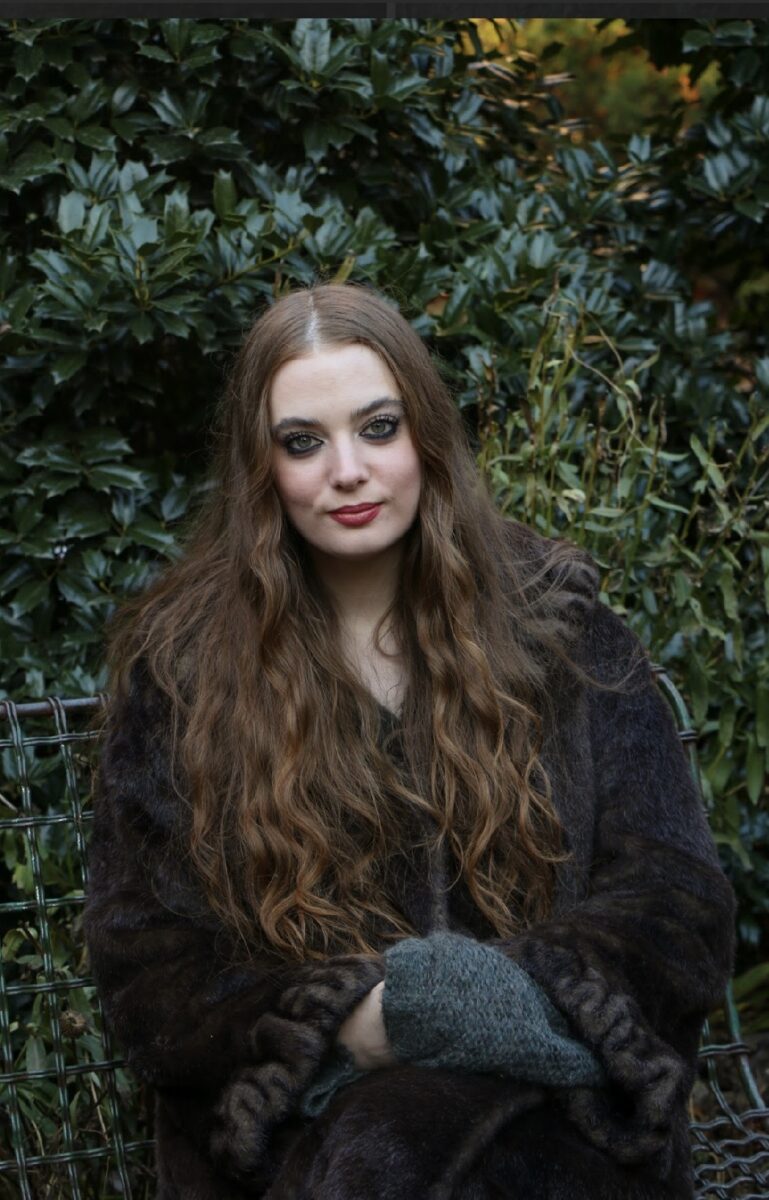
The first-person-plural narrator is very impactful. What were your intentions with this POV choice?
I wanted a voice that felt prophetic and impenetrable. By using a first-person plural POV, I hoped to underline that this is not a singular diverting voice proposing a challengeable belief system, but rather a story narrated by the belief system itself. The girls are so indoctrinated by this way of thinking that it impacts their every thought and action; they are the belief system and as such have lost their bodily autonomy, becoming a collective “we.” The girls briefly mention they are lapsed Catholics, and the title, “Fruit of Our Body,” is an allusion to the Book of Deuteronomy in the Bible. By including another didactic belief system, I hoped to show their history of searching for meaning. For the girls, it is not about what they believe but that there is something to believe in. They are soothed by instructive order. The plural POV is illustrative of this.
Did you have any challenges with making the themes of your story clear without being too on the nose?
This story found its origins in British folklore with the image of the lord and ladies plant and its phallic history and, although this didn’t make its way into the piece, the fact that they were used by nuns to starch linen in the fifteenth century. I was really drawn to this tension between moral purity and blatant sexuality. Rarely for me, I knew my ending before I began and, once I found the plural POV, the rest of the narrative unspooled from there. I didn’t want this story to be overly allegorical and I was conscious of that risk while writing. For this reason (and due to the small word count), I let the plural POV do a lot of the heavy lifting. Topics were deliberately introduced and then left uninterrogated. The girls don’t understand their own belief system. It is an inherently bizarre interaction and I think leaning into that confusion by refusing to overly-explain helped (I hope!) to prevent the story from becoming too on the nose.
The lack of physical details about the narrator is striking. If you were to give a description of their appearance, what details might you include?
I see a sort of homespun prettiness, lots of natural fabrics, wild hair and bare feet. As is alluded to in the opening lines, the girls view deodorant as toxic and I imagine they would avoid similarly “toxic” materials like makeup and SPF. They see themselves as part of the earth and so I picture them running wild in the fields and forests of the countryside, mud-caked and naked. My intention in leaving the girls’ appearance open was to give them an amorphous feel, as if their bodies had no distinct outlines, that they could flow into each other. It felt important to me for the girls to never fully acknowledge the materiality of their bodies. They view themselves as embodiments of the natural world trapped in a clinical, sterile environment—the antithesis of their belief system—and to reckon with their own physicality would destroy their self-image.
It feels important to note that while both the doctor and narrator are female, there’s some hostility between them. What would you say is the significance of this?
The doctor’s gender is significant to the girls within the story. They are analysing her for clues to determine if she is on “their side” in this battle that they perceive between the natural world and righteous hands-on work versus modernization and a shirking of responsibility. It is for these reasons that they are so enamored by the fact that she killed a rabbit. There is no plausible deniability here, no lawsuits, no chain of command, only a direct action, which the girls believe brings her closer to the natural world. Animals kill, not euthanize. The doctor sees them as they are, vulnerable women at risk of great harm. Had I chosen to depict the doctor as a man, this story would have become another instance of a man telling a woman what to do with her body and that wasn’t what I wanted to focus on. I wrote this story as a clash of belief systems. Inspired by girls falling down the trad-wife/alt-right pipeline but writ large and rendered absurd, in that my characters do not choose a man to impregnate them but a phallic-shaped plant.
What is your number one tip for writers who want to tackle flash fiction?
Read poetry, though I think this extends to all writers. Poetry distils language to its essence, demanding both sparseness and exactitude. The rules of traditional narrative are broken which gives rise to new ways of meaning-making that don’t rely on linearity or progression. I think flash fiction is the perfect place to play in a way that would be difficult to maintain for an entire novel. I continually return to Louis MacNeice’s Snow, Bhanu Khapil’s collection The Vertical Interrogation of Strangers, and, for short fiction that sits somewhere between prose and poetry, I love Giada Scodellaro.

 In September 2022 SmokeLong launched a workshop environment/community christened SmokeLong Fitness. This acclaimed community workshop is happening right now on our dedicated workshop site. If you choose to join us, you will work in a small group of around 15-20 participants to give and receive feedback on flash narratives.