Reviewed by D.E. Hardy
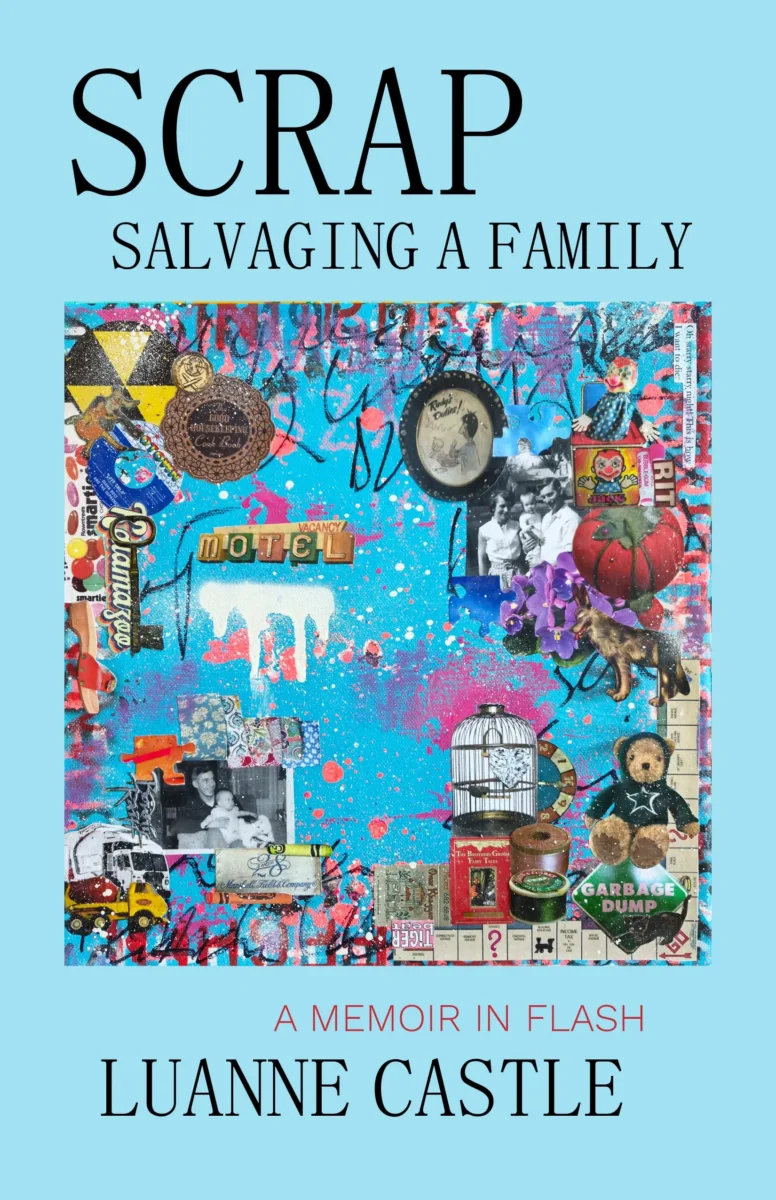
On page one of Scrap: Salvaging a Family, A Memoir in Flash [ELJ Editions, 2026], Luanne Castle declares her father Rudy a bastard. The word has three apropos definitions according to this hermit-crab flash: one, Rudy was born out of wedlock, a bastard in the parlance of the early 1900s; two, he and his siblings were the lesser, bastard family of his father, a doctor, who had another, claimed family on the well-heeled side of town; and three, Rudy, who we will quickly learn was prone to bouts of extreme anger and abuse, was a bastard, “mean[ing] he could be a genuine and legitimate dick.”
The bold confidence of Castle’s first story, “Bastard,” strikes me every time I read it. Candid. Arresting. Brilliant in its micro-length efficiency. But it’s the way this piece contrasts with the next, the titular poem, “Scraps,” that sets the tone of the book in my mind. In this enigmatic, quiet piece, we encounter Rudy as a scrappy boy, tired of fighting the world, desperate to craft a meaningful life out of the bits and bobs the universe has dealt him. The narrative voice is tentative here. Questioning. How do any of us scrap together cohesive cloth from the myriad fragments that constitute ourselves? We know what’s come before, what we’ve experienced. Yet, we’ll never fully understand what’s come before, or what we’ve experienced. Both are true, and Castle’s first two pieces, paired as they are, feel like a promise—this narrative will not shy away from complexity.
I heard a joke once that all writers agree on the hardest form to write—the one they’re working in. And so, as a writer drafting her own memoir, I sit in awe of Castle’s skill in navigating this, the most difficult of forms. There’s so much to grapple with in memoir. Crafting a family narrative can be particularly thorny. Our story is our own, and yet it’s inherently made up of the stories of everyone we know. Where does one person’s story end and another’s begin? How do you present a picture that’s true to your experience, one that stands up for you in your most vulnerable moments, yet honors the complicated lives of others, the intricacies of family dynamics, and the tight weave of intergenerational trauma?
Memoir presents a landscape pockmarked with rabbit holes that each writer must map and navigate anew because memories are tricky. Some are etched clearly, crystal in our minds. Others remain incomplete, hazy, ripe with untested assumptions. Which memories are “true”? Maybe that’s the wrong question. Maybe the answer is simply “yes.”
Castle nimbly stitches a quilt using literature’s scrappiest form—flash—to explore every corner of her theme: scraps of memory, scraps of history, scraps of fabric, scrapyard finds. She greets the challenges of memoir with a scrappiness of her own. Her narrative is inclusive and earnest without being apologetic or sentimental. She takes each era in turn—childhood, teen years, adulthood—with age-appropriate lexicon and tone. Castle leans on flash for its dexterity, variety, and pace as she tackles her family’s story. The mystery of Rudy’s father. Domestic abuse. Mental health. Her relationships with her mother, grandmother, brother, cousin, and uncle. We follow Castle through adulthood, all the way to Rudy’s death and her discovery of his half-siblings. The sheer scope of material might tie a lesser writer in knots. In Castle’s able hands, all these scraps become both metaphor and a stunning rendering of her life.
Always, though, the narrative comes back to Rudy. If his anger set the weather for their relationship, Castle’s need to understand him sets the weather for her memoir. “Why do I keep writing about my father?” she asks, declaring herself obsessed with his life and story. This obsession paves the way for much speculation, and the pieces in this vein are the ones I can’t stop thinking about. Castle retells Rudy’s childhood stories, and imagines his war years in Korea from his first-person perspective. A daring move. Later, in third person, she imagines her grandmother’s young adulthood. How she may have met Rudy’s father. How their life together might have been. The origin of a mystery diamond ring that was long in her possession. However close to the truth Castle’s renderings may be, I know we must label them fiction, yet that classification feels off to me. Isn’t this what we come to memoir to sit with—the parts of our lives we can never be certain of? Our wonderings and daydreams are as much a part of our memories as real experiences. Can there be a third category: nonfiction-fiction? Somehow, the term “hybrid” doesn’t quite get there. When you’ve lived with missing people, hidden histories that nonetheless govern your present reality, aren’t your speculations about them something meatier than make-believe? Castle seems to agree.
Ultimately, Scrap: Salvaging a Family is a meditation on the desire to connect the dots of one’s life, a narrative journey that endeavors to scrap together a lifetime of questions and hold them all in one place. An impossible task, but one that Castle fully embraces. The result is a smart and heartbreaking book that’s sincere and innovative. Cathartic. We are the things we know and the things we don’t understand, Castle suggests—and all the years of wondering and imagining, too. Our story comprises all these scraps—the questions we’ve asked and the answers we’ll never get—each a profound part of our truth.
Scrap: Salvaging a Family is available now in paperback and e-book from ELJ Editions.
Luanne Castle has written four award-winning poetry collections. Her Pushcart, Best Small Fictions, and Best of the Net-nominated writing has appeared in Copper Nickel, Verse Daily, Saranac Review, Bending Genres, The Ekphrastic Review, MacQueen’s Quinterly, South 85, Roi Fainéant, and River Teeth, among many other journals and anthologies. Luanne holds an MFA in creative writing from Western Michigan University, a PhD in English from the University of California, Riverside, and a certificate in creative nonfiction from Stanford University. She grew up in Kalamazoo, Michigan, but currently lives with her husband and five cats in Arizona along a wash that wildlife use as a thoroughfare.
____________________________
 D.E. Hardy’s work has been twice nominated for a Pushcart Prize and anthologized in Best Small Fictions, Best Microfiction, and the Fractured Lit Anthology Series. She is the founder and EIC of Claudine and on staff at Chestnut Review and The Offing. D.E. earned a dual MFA in fiction and nonfiction from Antioch University. She lives in the SF Bay Area. Her works in progress include a novel and a memoir.

 In September 2022 SmokeLong launched a workshop environment/community christened SmokeLong Fitness. This acclaimed community workshop is happening right now on our dedicated workshop site. If you choose to join us, you will work in a small group of around 15-20 participants to give and receive feedback on flash narratives.