Reviewed by Brandon McNeice
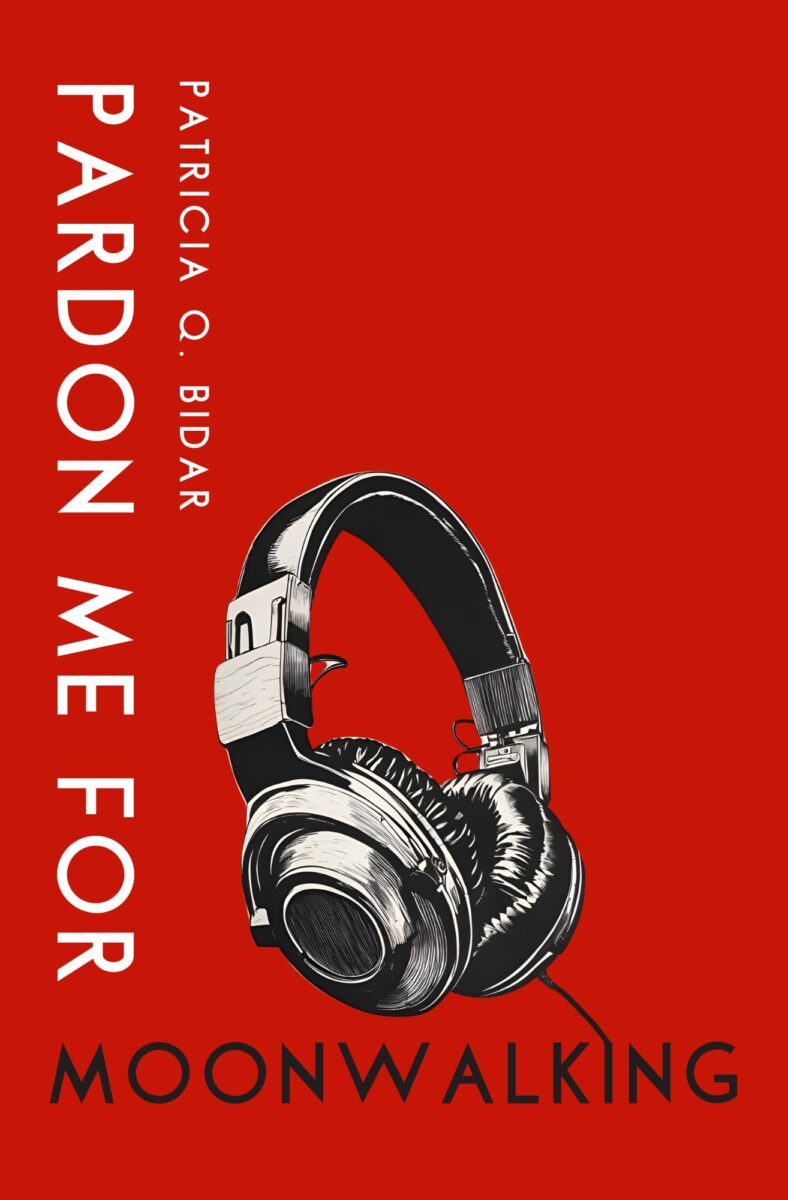
A cheap lime green phone charger sits on the counter in the flash fiction “Over There” like an accusation, a small object that somehow contains a whole day. Patricia Q. Bidar’s collection Pardon Me for Moonwalking [Unsolicited Press, December 2025] is full of ordinary items and ordinary scenes that carry more weight than they ought to, weight you don’t notice until you try to lift it. The stories move quickly, as flash must, but they don’t hurry past consequence. They tend to end in what comes after–not the lesson, not the speech a character might give about what happened, but the bodily remainder, the way a scene keeps replaying when you’re alone.
“Over There” is one of the collection’s strongest demonstrations of how Bidar builds a moral situation out of fluorescent banality. Two brothers meet in a CVS and their bond is stated without decoration, “Charles is my blood and what he feels, I feel.” Then the story immediately turns feeling into sensation, “From the overhead vent, a soft breeze cools the sweat of his neck.” The cashier assumes they are strangers because they haven’t greeted each other, a tiny social misread that becomes its own kind of ache, as if even the public script is wrong for them. The lime green charger is there from the start, and when the narrator asks what happened, the answer arrives with a jolt of absurdity that is also grief, “It was stolen. From the coffee shop!” Bidar makes the narrator’s recognition sensory before it becomes moral, “Now it comes to me: my brother’s smell. The greasy suit, the unwashed hair.” The scene tightens around groceries and small humiliations, eggs, bacon, wine, the request for “$20 ‘cash back’,” forming the line behind them. In Bidar’s stories, love happens in public, and shame does too. The story’s most revealing detail is also its funniest, which is why it works. The narrator palms his brother a twenty, the brother nods and “passes wind,” and Bidar writes, “Isn’t it the strangest thing, how a person’s farts can smell exactly the same after years…” It’s an intimacy no one would choose as evidence, which is why it feels true. The ending doesn’t resolve the brothers. It shows what the encounter does to the narrator’s next day. “‘I’ll still be thinking of him when I awaken in the morning,’ he says, ‘I’ll think of my brother’s half-salute as I fry up my bacon and eggs, grease seeping into my clothes.’” The residue is the point, how a brief public meeting stains the routine that follows.
“The Ghost of Charles Bukowski Pines for His Job at the Mails” shifts into a more overtly playful register, and it’s a good reminder that Bidar’s tenderness isn’t soft. The opening line is clean and slightly cruel, “Death has done wonders for Hank’s cratered face.” The premise could have stayed clever, dead Bukowski as a joke about literary myth-making. Instead, it becomes a story about labor and longing, about the strange comfort of structure. Dead Hank doesn’t miss the romance of being Bukowski so much as he misses the daily friction that kept him anchored, “his old job at the Post Office. The Mails. A time-clock to cheat.” He misses “the rolling stool. The bank of letterboxes. The dragging clock. His jackass supervisor.” Then an unembarrassed truth: “Something to rail against.” Bidar’s flash doesn’t redeem drudgery, but admits what freedom can take away–the steadiness of a routine you can hate and still rely on.
The title story gathers the collection’s central anxieties into one social motion, the risk of being seen and the cost of trying to perform belonging. “Pardon Me for Moonwalking” opens with immediate vulnerability, “We weren’t much more than halfway to Bill and Lila’s place at the Russian River when the drugs kicked in.” The sentence has that Bidar quality, situation and danger delivered casually. The story moves into a party atmosphere where bodies and music and social scripts all press at once, and then, in a few quick beats, the humiliation lands. “Smooth Criminal” blares. The narrator attempts the book’s titular motion. “Then I did it: began moonwalking,” she says, and immediately, “Of course, I fell.” The sharpest moment follows, “The music continued but the conversation did not.” Bidar compresses the whole feeling of shame into one line, the sense that time keeps moving but you have been pinned to the floor. She calls out “Pardon me! Pardon!” and flees, and Bidar makes the aftermath even harsher by giving it clarity. Outside, she sees what she did not want to see, “Dawn’s thumbs were in Rocky’s belt loops. I could smell his cologne.” The story doesn’t need to explain what happened while she was inside trying to be effortless. The final images do the work. “Something felt cool and soothing between my toes,” she realizes, “I’d stepped on a banana slug.” Comfort arrives in the wrong form at the wrong time.
Across the collection, Bidar’s endings often cut away while the emotion is still accelerating. For some readers, that will feel like being left at the edge of a sentence, wanting one more beat that pins down what the character cannot or will not say. For others, it will feel like fidelity, a refusal to tidy what is still moving. A smaller limitation, if it’s one, is tonal range. Bidar’s signature leans consistently wry, attentive to awkwardness and social misfire, and even when the ache is deep the prose tends to keep its dry composure. That steadiness is part of the book’s personality, but a reader looking for more volatility, more tonal whiplash between pieces, may find the collection’s temperature deliberately contained.
Pardon Me for Moonwalking is at its best when Bidar lets a concrete thing carry the emotional truth without announcement. The stories don’t ask to be admired for concision. They ask to be noticed much later, when you’ve left the scene and the book is still in your hand.
Patricia Bidar’s collection Pardon Me for Moonwalking is available now from Unsolicited Press and Bookshop.
____________________________
NOTE: Patricia Bidar is a current Submissions Editor at SmokeLong Quarterly.
 Brandon McNeice is a Philadelphia-based writer and educator. His work has appeared or is forthcoming in Commonweal, Plough, SmokeLong Quarterly, Flash Frog, Hunger Mountain, Flyway, Bending Genres, and ONE ART. A two-time Best Small Fictions nominee, he writes about the daily negotiations by which people seek dignity, faith, and decency inside systems that are anything but simple.

 In September 2022 SmokeLong launched a workshop environment/community christened SmokeLong Fitness. This acclaimed community workshop is happening right now on our dedicated workshop site. If you choose to join us, you will work in a small group of around 15-20 participants to give and receive feedback on flash narratives.