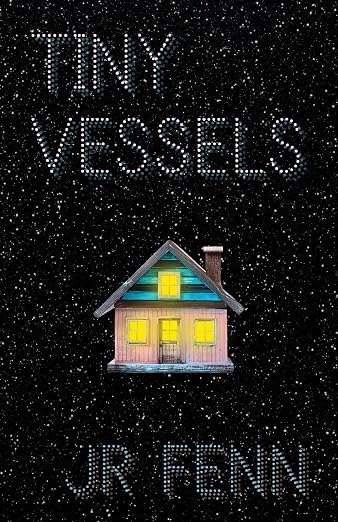
Reviewed by Emily Webber
“Memory Box” opens JR Fenn’s chapbook of flash fiction, Tiny Vessels [Red Mare Press, February 2026], with a sentence that evokes an ordinary image of kids left to play outside on their own. Fenn writes, “It’s a cold week, the atmosphere thin, but like children everywhere, they refuse to acknowledge that sweaters exist.” Then this sentence: “Gold is just a word in the history lessons, like T-Rex and Dodo and Earth.” Since “Earth” follows familiar words like “T-Rex” and “Dodo,” the meaning hits us with quiet force. Earth is now only part of history books like the others. We immediately know this world is different because of the subtle details: the sky is a dark reddish-brown, the casual familiarity of Mars, and the history lessons. Yet it could be our future, too.
As the children play, their father tries to recreate the things they’ve lost. We haven’t yet lost the ability to feel the rush of running water, the bliss of eating a perfectly ripe tomato, or the comfort of a dog. But we read “Memory Box” and watch as the father makes the children feel intense yearning by sparking memories of things the children can never get back. In turn, it helps the reader understand what it would be like to permanently lose the things we typically take for granted.
Fenn’s stories are built on memories of the past, imbued with a longing for the things we have destroyed or lost. There is emptiness and destruction—war, wind, dirt, dust, empty spaces, and people flung far from their homes. Fenn writes,
Some parts of us die before the others. The wind whips the car with the force of a comet’s tail. The gust flattens the fields, dust dashes against the windshield, glitters up and away. It sends shivers through my spine, my body bent on a point inside that expands faster than fireflies loosed through the mouth of a glass bottle. I have seen my firstborn run away, laughing. Part of me will stretch outside myself, spreading with my daughters over places I’ll never see. Part of me will stay here, tired and small, as the world dies around me in fresh, clear breaths.
In “The Cherry Tree,” a storm splits a tree, and it must be removed, revealing the violent feelings of the man hired to take it out. In another story, “Hedgies,” stuffed hedgehogs are kept safe in cardboard houses, leaving the reader to wonder how safe the world outside remains. A shopping trip in “Always” takes place in extreme weather in a place where credit has no value. Some of the dangers in Fenn’s stories are outright and fierce—a destroyed planet, drone strikes, war, and floods. But the danger in some stories is hazy, appearing on the outside or tenuously kept at bay. This heightens the sense of dread, that the chaos and strangeness in these worlds will only increase, even if it is off the page.
But there is also kindness from a stranger, objects that provide comfort, a turning back to nature, childhood memories, and lasting gifts passed through generations, even amid the destruction. Fenn writes, “Our lineage terraformed the dark side of the moon into fruit-bearing orchards. Those carrying our mothers’ spirits dyed cloth with vermillion husks, wove it with starstuff, and dwelled forever in tents of beauty.”
A character tells of their childhood love for a small matchbox, particularly, “The way the drawer slid open to reveal a tiny holding place.” Each of the stories in Tiny Vessels is small enough in form to feel like a tiny matchbox, yet the collection opens and pours out a world of stories, prompting us to think about our own world and what is at stake for us.
I’m a firm believer that works of fiction placed in worlds that look very much like our own, or hint at our present as the past, are one of the ways in which we can come to understand ourselves better. Tiny Vessels gives us the ability to see beyond the impossibility of change in our current moment, to view ourselves with kindness and heartache from a different angle, and maybe even change our ways.
Tiny Vessels is available now for purchase in paperback through Red Mare Press via Bookshop.
JR Fenn writes about the living web of the human and more-than-human world as it changes over time. Her work has appeared in many places, including Boston Review, DIAGRAM, Split Lip, PANK, 100 Word Story, the Bath Flash Fiction Anthology, and the Bristol Short Story Prize Anthology. She is a graduate of the MFA program at Syracuse University, where she was awarded the Joyce Carol Oates Prize in Fiction. Other recognitions include the Gulf Coast Prize for Nonfiction, the 59th Annual New Millennium Award for Flash Fiction, and Stone Canoe‘s Robert Colley Prize for Fiction. Her work has been supported by the Key West Literary Seminar, the Orion Environmental Writers’ Workshop, Writing by Writers, The Writers’ Colony at Dairy Hollow, and Hewnoaks, among other places. She teaches Fiction and Environmental Writing at State University of New York College of Environmental Science and Forestry and lives in Western New York with her family.
______________________________
 Emily Webber is a writer of criticism, fiction, and creative nonfiction. Her work has appeared in Rain Taxi, the Ploughshares Blog, The Rumpus, Writer magazine, America Media, and elsewhere. She’s the author of a chapbook of flash fiction, Macerated.

 In September 2022 SmokeLong launched a workshop environment/community christened SmokeLong Fitness. This acclaimed community workshop is happening right now on our dedicated workshop site. If you choose to join us, you will work in a small group of around 15-20 participants to give and receive feedback on flash narratives.