Reviewed by Brett Hymel Jr.
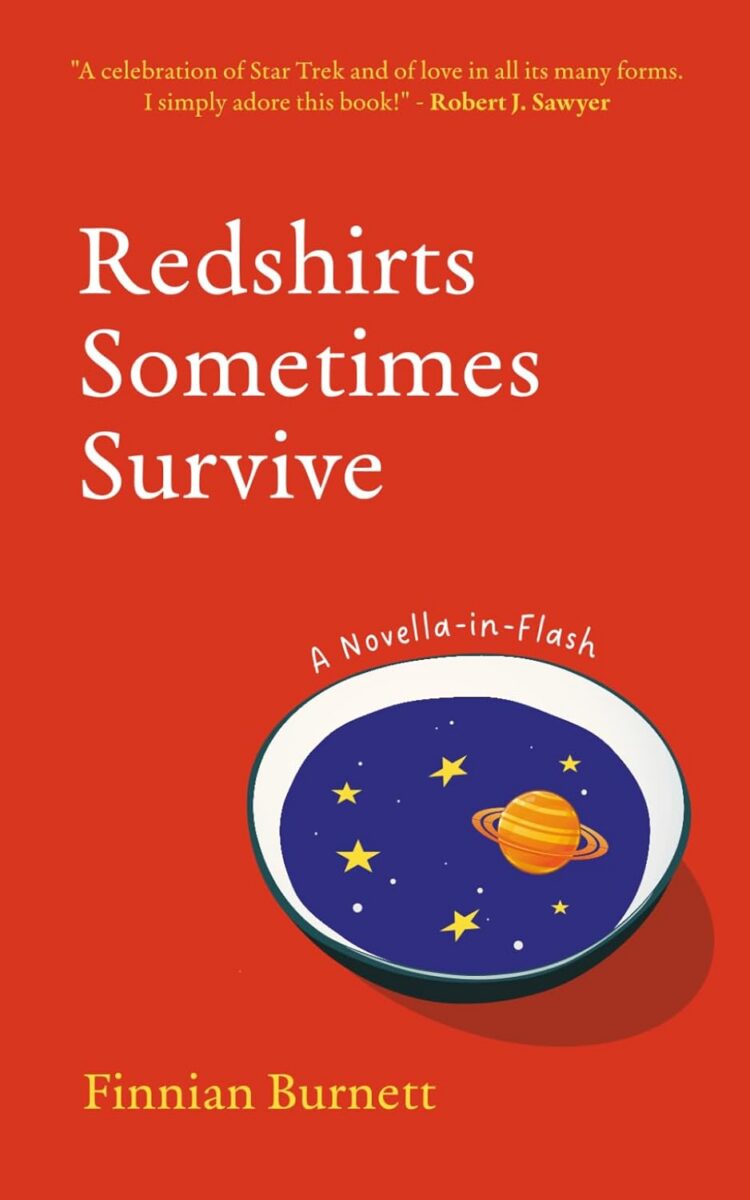
I have Redshirts Sometimes Survive [Off Topic Publishing, 2026] opened in a tab on my computer. My other tabs: the Wikipedia page for Wesley Crusher, the Wikipedia page for Kathryn Janeway, and a Google search that says, “Spock is the guy with the ears?” Before you close the tab on this review, let me argue that this—my grotesque lack of context and background knowledge—will make for, at the very least, an interesting read. Of the many varieties of nerd across the spectrum of literature, Finnian Burnett’s novella has fallen into the hands of a reviewer who never paid much attention to Star Trek.
It needs to be said, up front, that Redshirts Sometimes Survive is not a piece of fan fiction, but rather fiction for fans, and if the distinction feels slight, it’s also important. The disparate flash pieces in Burnett’s novella share two things: an unabashed love of Star Trek and a furiously beating heart. The novella isn’t so much interested in debating the finer aspects of the show, but in addressing how such a fandom can provide a backdrop for a life. Burnett poses the question: in a world in which so many of us were raised by media, how does media about media help us think about our own lives?
The title is a riff on the show’s trope, the notion that redshirts—the lower-ranking crew members—must always die to push the plot forward. Burnett reimagines the myriad narrators—the adaptable I, collective we’s, and a recurring protagonist named Teddy—of the novella as the redshirts of the world: the overlooked, misunderstood, and abandoned. There are real stakes here—specifically in pieces like “Teddy and His Lunch Ladies” and “What Would Janeway Do?”—but the stories never linger on tragedy, never indulge in sadness. Burnett’s book about survival is, unsurprisingly, about surviving. And in that survival is a real joy.
The writing is at its most poignant when Burnett works with a sense of euphemism. Pieces like “When Captain Picard Was My Dad” break our hearts slowly, on account of the simple negation, the filling-in of blanks between what a dad is supposed to be and what a father actually does. More directly, the flash “For the One Who Didn’t Make Captain” reveals itself in what is explicitly left out of the casualty report, the agonizing self-taunts literally stricken-through, a la the startling initial confession, “fuck, I wish I’d used their name more.” There’s a desire to articulate things that can’t be named: the hurt of growing up neglected, of having identity denied, of being raised by narcissists and bullies, and Burnett’s flash often takes us to a crucial point in which that articulation can’t be said. It’s not for nothing that Teddy’s stories are always narrated by a we. The we is sometimes lunch ladies, sometimes workers in a juvenile detention center, sometimes volunteers at a convention, but they’re always concerned, overfull of love they want to heap on Teddy without ever being sure how.
That how is the central question at the core of Redshirts, what’s offered in place of the palliative, curative sentence: a Trekkie shirt, or a figurine of Spock, or Data, a bit of banter and a playful question about captains. When the hurt becomes too heavy to speak into existence, Star Trek takes its place. This language, the language of fandom, becomes a translation device. Instead of asking for the airing of dirty laundry—too on-the-nose, direct, or telegraphed—the characters reconcile through questions about Star Trek, ideas that feel both accessible and nuanced in their choice.
Redshirts isn’t a nostalgia tour or a victory lap for fans of a sci-fi franchise. Well, maybe it is, but it isn’t only that. The purpose of media about media (and this excellent novella in particular) is to provide a framework for how to apply that love to our everyday lives: ourselves, our communities, and the world around us. A stellar example of this exists in “What Would Janeway Do?” when the ponderings about the show meet the very real bulkhead of fascism. Burnett writes, “…for once in my life, I’m not that quiet one standing in line with an Admit One ticket tucked up my sleeve so I don’t lose it.” In the same way that Gen Z protestors in Nepal flew One Piece flags, the narrator uses media as a model for action: the show provides us with a schema for heroism. All we need is to follow the blueprint.
At the end of Redshirts, I’m a bit surprised at how accessible the novella is for non-Trekkies. For somebody who saw Wrath of Khan once, when he was eight, I don’t feel lost or confused. The stories have a heart that beats separate from fandom, and this heart is legible enough to any human. The book is almost overwhelming in its radical acceptance, its unabashed embrace of love and kindness, the relentlessness with which it speaks to the neglected, the outsider, the weirdo. Burnett doesn’t just wave you over–they demand you sit down next to them, insist that you feel welcome in this space. The fandom is too large for exclusion or hatred.
Our communities teach us to be kind. Our television shows teach us to be brave. Redshirts sometimes survive, yes, and they are often heroes. And if we are redshirts too, what’s to keep us from being heroic?
Vulcan salutes in the air.
Found family includes readers as well.
Redshirts Sometimes Survive is available now for purchase in paperback from Off Topic Publishing or the ebook at various retailers.
____________________________
 Brett Hymel Jr. writes stories for bugs. These stories can be found in The Cincinnati Review, Split Lip Magazine, Subtropics, Black Warrior Review, Puerto del Sol, and elsewhere. His criticism appears in SmokeLong Quarterly and Colorado Review, and he teaches English and creative writing at Louisiana State University. Death threats can be sent via his website, which he pays an embarrassing amount of money to keep running: www.bretthymeljr.com

 In September 2022 SmokeLong launched a workshop environment/community christened SmokeLong Fitness. This acclaimed community workshop is happening right now on our dedicated workshop site. If you choose to join us, you will work in a small group of around 15-20 participants to give and receive feedback on flash narratives.