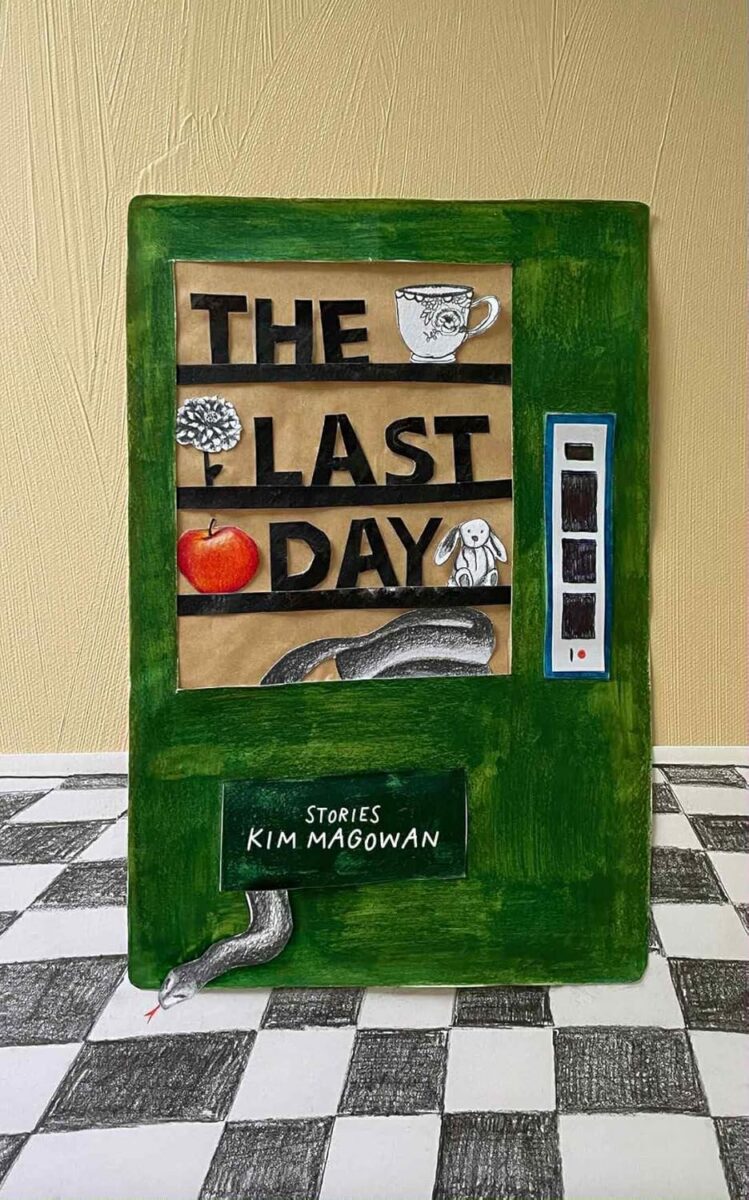
Reviewed by Erin Vachon
In the titular story to Kim Magowan’s The Last Day [Moon City Press, March 2026], a narrator finds a High Voltage dahlia that looks like a crimson loofah. She texts her husband a photo of the bizarre flower, and he texts back a red spiky Muppet. The narrator texts a smiley face. The husband texts a GIF of a man electrocuting himself, finger stuck in a socket. Magowan’s narrator says of her flower, “Behind the dahlia, I see only green plants.”
On the day I read Magowan’s fourth flash fiction collection, I take a hike through the back woods of Rhode Island and find what my iPhone identifies as a Pink Lady’s Slipper. A singular blotch of fuchsia blooms amongst endless green. This discovery feels like a sign, though, of course, it’s commonplace. But doesn’t the truest magic spring from the mundane? I’m thinking about flash fiction as I gaze at the photo of the pink flower, though I think about our craft quite a lot. Depending on who you talk to, flash is either a new genre or an age-old one, if long hidden among the persistent greenery of novels and short stories. Carving a path as a flash writer takes a certain tenacity, even more so to maintain course. If you’re on the side that says flash fiction is mere decades old, Magowan is one of our most trusted pioneers. Her stories feel effortlessly funny, like a friend delivering savage one-liners, barely cracking a smile. Magowan’s characters skew cranky and self-investigative, all fleshed out in short space.
If the narratives in The Last Day plant themselves firmly in realism, common intimacies and irritations turn strange under Magowan’s steady hand. When her dahlia photographer waves hello to another New York mother, the narrator asks herself: “Why does perfectly friendly Marisa annoy me so?” She concludes Marisa is too flirty with her husband, but I’d venture the author’s sensibility peeks through here: a healthy skepticism of anything too shiny, especially when that something is unearned. Magowan’s narratives privilege the prickly and the peculiar, the wildflowers long overlooked.
In seventy-one stories, Magowan offers grounded characters who face real-world relationship dilemmas. They have jobs, kids, histories. They’re as judged as they are judgmental. Yet Magowan often stretches small interactions to delightfully outsized proportions. A protagonist can’t help drawing her husband’s nose in caricature, way too big. A woman writes a letter to a newly divorced man, expressing support for him over his ex, based on her play-by-play analysis of their wedding favor distribution. When Magowan writes understated dialogue, she also hits you sideways with metaphor, like marriage described how “a flashlight casts its pie wedge over pine needles; obscure shapes crouch in the dark.”
If Magowan’s characters nurse resentments, they’re tough as hell. Her protagonists shift their lives forward, battle-worn, if exhausted. Betrayal arrives in all permutations of plot, from petty to serious, sometimes both at once. A woman chastises her husband for mauling bread off the loaf instead of slicing. A man mocks his lover’s favorite show as “aristoporn,” except she knows he’s going to the bar with “awful Glenda” later. A narrator analyzes the precarious role of stepmothers by way of Prince Harry and Camilla. A protagonist can’t stop thinking about an old lover who liked to role-play as the Virgin Mary and the Holy Ghost during sex, musing, “She didn’t know what was in Paul’s head, how he pictured their copulation: Was he corporeal? Or vaporish, more of a diffuse cloud?”
Even though The Last Day is mostly realist, Magowan’s characters trust the surreal wisdom of their dreamscapes. In dream, a narrator bartends for her husband, ex-boyfriend, and the love of her life. A woman writes an email to a potential lover, after dreaming her boyfriend caught her cheating with an ex. A couple in “Burying the Body” compare their worst dreams. In hers, she offended someone online and “watched the number of retweets climb.” In his, he killed a woman and buried her body. Magowan does not pull punches. The most devastating moments in her work arrive unexpectedly. The couple in “We Tried” repeat the title phrase over and over to tragic end, landing at the knowledge that even superhuman effort might amount to absolutely nothing.
When I look at the photo I took of that Pink Lady’s Slipper, I consider Magowan’s keen ability to create precious narrative biospheres. In the titular story, the husband of the photographer explains his theory on why dahlias are her favorite. “They had the most range,” he says, “In color, in shape, and most of all, in their scale between ridiculous and elegant.” He might well be describing his author’s capabilities as a flash writer. Magowan boasts an elegant skill at balancing the ridiculous inside the everyday. You’ll keep turning the pages of The Last Day for crimson pops of revelation, then beg each successive story to break your heart, again and again.
_____________________________
 Kim Magowan’s newest collection The Last Day: Stories is available now for purchase from The University of Arkansas Press or Bookshop. She is the author of the novel The Light Source and three previous short story collections: Don’t Take This the Wrong Way, co-authored with Michelle Ross, How Far I’ve Come, and Undoing (2018), which won the 2017 Moon City Press Fiction Award. Her stories have been selected for Best Small Fictions and Wigleaf’s Top 50. She serves as the Editor-in-Chief and Fiction Editor of Pithead Chapel. She lives in San Francisco with her family and teaches in the English Department of Mills College at Northeastern University.
 Erin Vachon is the Senior Reviews Editor at SmokeLong Quarterly and the Multigenre + Chapbook Editor for Split/Lip Press. They are on the English Department Adjunct Faculty at Rhode Island College and live outside Providence, Rhode Island.

 In September 2022 SmokeLong launched a workshop environment/community christened SmokeLong Fitness. This acclaimed community workshop is happening right now on our dedicated workshop site. If you choose to join us, you will work in a small group of around 15-20 participants to give and receive feedback on flash narratives.