I’m fascinated by the ambiguity in reality and narrative roles for the only two “real” characters, the father and the narrator. What was the thought process behind crafting that sort of narrative?
I’m glad you put “real” in quotation marks since I want to leave the question of reality open.
I wanted to give the impression of a mystery locked behind the narrative. If the difference between reality and fantasy could be determined, would the mystery be unlocked, and the pieces of the puzzle fall into place? At the same time, I wanted to subtract some of the pieces of the puzzle, so to speak. This wasn’t a conscious process at first but gradually developed as I wrote multiple drafts. Much of the first draft of the story was written in separate notes on my phone, in short blocks that felt like I was adding different pieces of the narrative that could be moved around in a modular way. Maybe a better way to describe the process is that I was searching for the answer to the mystery myself, and the story is the record of that search.
The use of second person in the story is very effective at adding to the uncertainty of the story. Did you have a specific motivation in using that point of view? Do you often make use of it in your stories?
I’ve always loved reading the weird interiority of the second person, but I rarely write it. To me it sounds like an inner voice speaking to the main character from some place the main character doesn’t understand. So, is the “you” a character, a narrator, or both? This ambiguity suits the story and might be what drove the writing of it in the direction of greater and greater uncertainty.
It wasn’t a conscious decision to write in the second person. The story began as a sentence that was already in the second person when it came to me, like a voice inside myself speaking to me.
Did the title of the piece just come to you while writing, or was it a starting point that you worked the rest of the piece around?
The newspaper headline came out in the initial drafting and was perhaps the biggest surprise to me in the writing process. It haunted me. It seemed to add yet another layer to the story I couldn’t explain, and I wanted to keep that inexplicable quality alive in the story. That meant it had to be the title.
The theme of fire and flame throughout the piece is often accompanied by the imagery of the moon. Do you see a connection between these two images, or did you just find them striking? Are they of particular importance for your character?
I love that you’ve highlighted how central this contrast is to the story, one that suggested itself to me only because the story began with cold and night and it seemed natural to move the story toward not just warmth, but something stronger. Emotionally, then, the story would begin with an inward, anxious fear and move toward the full expression of something like rage. I’m drawn to the elemental simplicity of these images of moon and fire, cold and hot, dark and light, reflected glow and burning flame.
I was very intrigued by the way the story gives a large presence to the father and keeps the brother relatively scarce, compared to the bigger role of the sister and the reduction of the mother to an inanimate object. Was this an intentional juxtaposition of the characters around our narrator, or a happy accident? Is there an element of gender and family dynamics at play here?
The main character is caught in this terrible family dynamic of an overwhelmingly present, violent father and a mother who has been reduced, as you point out, to almost nothing. This was how the story began in the first draft. Then I thought to give the main character a traditional, “balanced,” family composition—mother, father, brother, sister—and to show it as severely unbalanced. What seems like a “natural” family structure is undermined; there’s something wrong with the family, maybe with “family” in general. Even when the family dynamic shifts away from the initial extreme unbalance, it doesn’t right itself but only moves toward extreme unbalance in another direction.
Perhaps the initial opposition of father and mother suggested a similar opposition between brother and sister, as well as an opposition of brother and father, sister and mother. The brother is on the sidelines, in another space or looking on as a witness to the main action, while the sister is not just active but decisive. She’s the one who lights the match; she’s the one who jumps out the window. To return to the previous question about moon and fire, the moon is associated with the dead mother and the fire with the sister’s decisive actions, as if the sister steps in to fuel an escape from the father that the mother was unable to achieve herself.
Of course, these elements and oppositions are within the main character as well since it’s unclear where the boundaries between reality and fantasy lie. I hope I’ve said enough, but not too much, to allow the reader to make their own interpretations of the family and gender dynamics. It’s important to me to emphasize that there is no “normal” in this story, that binaries break down and are constantly shifting.

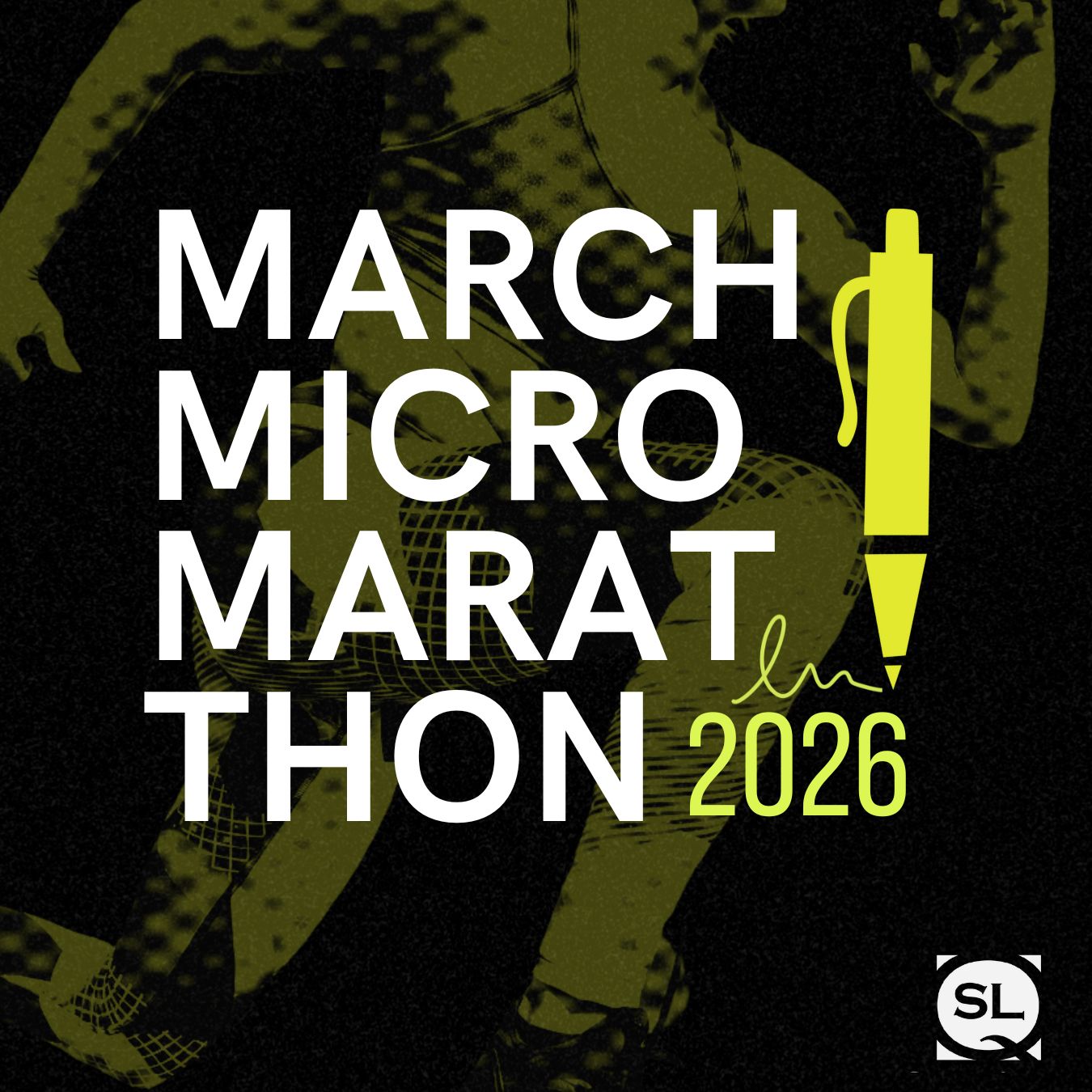 In its third year, The March Micro Marathon will be, as usual, a prompt-a-day whirlwind for 24 days. You’ll exchange drafts of micro fiction, non-fiction, and prose poetry in small groups and gather for a series of online events (all recorded for participants unable to attend live). We’ll finish with 3 competitions, and participants who are not already in SmokeLong Fitness will be invited to workshop with SmokeLong Fitness until the end of April!