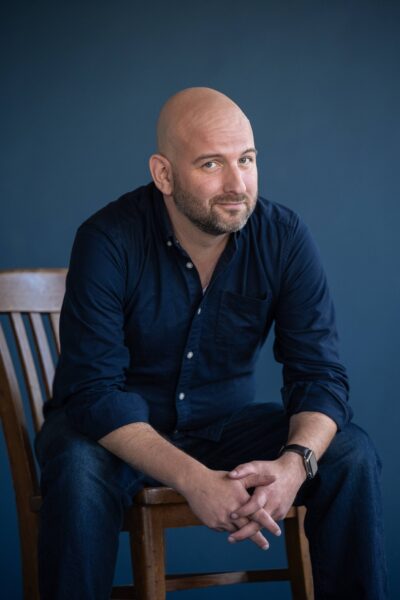
I’ve always been fascinated by second-person stories. In “Slack,” the point of view character has few specific details which lets each reader project themselves into the story. Yet even a moment like the memory of learning to reattach the chain by a neighbor isn’t one that every reader will have. What decisions did you make in order you thread the needle between a blank-slate character while also giving enough characterizing details to let the story take on a life of its own?
The funny thing is that the first draft of this story wasn’t in second person at all. It was in first, and it just wasn’t working. It felt overexplained and somehow distant. When I tried it in second, the story immediately pulled the reader much closer. My flash stories don’t always start out with the intention of producing a flash piece. The story eventually tells you what it needs. I’ve had much longer stories slowly revise themselves into flash pieces and I’ve had the opposite unfold as well. It would certainly be more efficient if I could tell, in advance, what the end result would be. That just isn’t the way it plays out for me.
I think we underestimate how much character can be communicated with very little explicit backstory. I’d love to say the “empty vessel” quality was a deliberate goal, but it really came from cutting. The early draft was much longer, and I kept removing anything that felt false or unnecessary. I’m drawn to flash in part because it lets me write that way: start big, then prune hard.
What remained were a few tactile details—the chain, the grease, the neighbor’s lesson—and almost no biography. The hope is that the “you” feels real but stays porous enough for readers to inhabit.
Obviously, a lot of readers will have a childhood filled with summers full of bike wrecks and licking their own wounds just like both the POV character and boy in this story. How did nostalgia play a role in drafting this story?
Nostalgia was present for me, but not as simple longing for an easier time. It was more like what Proust describes: the present becoming a trigger that opens onto a hidden architecture of memory.
In “Slack,” that trigger is very small—a chain slipping, the copper taste of blood, a kid licking his own wound and saying it tastes like a penny. Those details come from that deep storehouse of remembered sensation, but I wanted to keep the edges sharp. Childhood isn’t just carefree; it’s scary and painful and confusing.
So, nostalgia here is really about continuity. The adult “you” stands there feeling the old sensations reawakened in the body, and the present scene becomes a window into that whole buried structure of recollection.
Between these two characters exists a shorthand. Almost every line of dialogue is a fragment, occasionally a single noun. What is your approach to writing dialogue?
Honestly, I don’t have a formal approach to dialogue beyond how it sounds. It’s the part of writing where I most rely on intuition. I always read it out loud, sometimes as I’m typing. That ear test is essential for me; if it doesn’t sound like something these specific people would say, it has to go.
In this story, I wanted to capture the understated way men often speak to each other, even across a big age gap—short phrases, half-sentences, a lot of implied meaning. The fewer words they use, the more weight each one carries. So, I keep trimming until only the necessary fragments are left. Ideally, the real conversation is happening underneath those bits of dialogue, in the pauses and shared attention to the task.
Especially in the ending of “Slack,” the language becomes much more lyrical, which makes sense for a fiction writer who also writes poetry. How does this multi-genre background inform your work?
Poetry has trained me to pay close attention at the level of the line: rhythm, repetition, and the way images resonate with one another. In “Slack,” the chain, the idea of slack, the wheel’s wobble, all of those function as a small image system the sentences keep circling.
When I draft, I start fairly straightforward: what happens, in what order. In revision, the poet in me begins to lean in. I look for places where the language can lift slightly without breaking the realism, especially near the ending. That’s where the prose can become more lyrical, trusting echoes and images to do some of the work that exposition might do in a longer piece. Poetry and flash meet for me in that shared commitment to compression and resonance.
At the heart of this story, there is education. The “you” character once was taught how to fix their bike by a neighbor, and now many years later, this technique is taught to the child. And yet there are still so many identical boys with their own bikes just a block away. In some way makes it a perfect metaphor for being a teacher. Do you feel like flash fiction is particularly suited for metaphor?
My entire career has been in education. I currently lead a school in Southwest Philadelphia that serves an historically marginalized neighborhood. Given that, it’s probably inevitable that themes of teaching, learning, and the small worlds children inhabit show up in my work. The dynamic in “Slack”—one small skill passed along in a brief encounter, with the awareness of all the other kids you can’t reach—feels very true to the experience of teaching.
I don’t know that flash is uniquely suited to metaphor, but its constraints make metaphor especially useful. Flash demands a compression of meaning. You have only one scene, maybe one gesture, to suggest something larger. Devices like metaphor, allusion, and symbolism let that small moment stand in for a great deal more than it describes outright.

 In September 2022 SmokeLong launched a workshop environment/community christened SmokeLong Fitness. This community workshop is happening right now on our dedicated workshop site. If you choose to join us, you will work in a small group of around 15-20 participants to give and receive feedback on flash narratives—one new writing task each week.