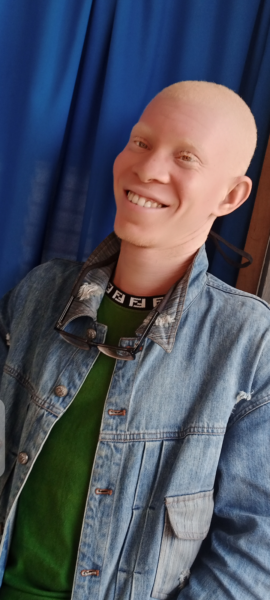
For the uninitiated, who/what is ojuju-kalaba? Who/what is ojuju-kalaba in this story?
Ojuju-kalaba is a mythical entity in Nigerian urban legends used to scare children and to compel them to do (or not do) whatever the adults want. Sometimes, ojuju-kalaba is interchangeable with a masquerade (which is feared by children because of its costume, its wild disposition and stories woven around it), sometimes with a ghost, sometimes with a mysterious old man/woman with a bald head and long fingers capable of sucking blood.
In the story, Ojuju-kalaba is a metaphor representing the narrator’s father; the mother created it to “protect” her children from their father’s tyranny.
Are the inconsistencies in how ojuju-kalaba is described (for example: both bad-bad and really nice) an intentional choice on your part to make them seem kind of all-encompassing or is it more a function of the mother’s weariness at her child’s prodding questions? Is she just saying whatever she needs to say to make the questions stop and to get her child to do as she’s asking?
None of the words in the story is directly mine! We know the mother is making excuses for her husband, right? So, yeah, she might have gotten a bit conflicted having recreated her husband in such a bad light and now, realising, possibly, how damaging it could potentially be (for the daughter) and how devastated she might get if she eventually finds out, she decides to concoct these good aspects of the ojuju. It could also be another aspect of her coping mechanism (what many Nigerian women in abusive homes tend to do): perhaps her husband isn’t that bad; perhaps she’s overthinking; perhaps, by telling her daughter all of that (and forcing herself to believe them), they might come true someday—something like that.
Why did you choose to tell this story from the perspective of a child?
There were two drafts before this one. The first, told from the mother’s POV; the second, from a semi-omniscient’s. Questions arose from the two. The first: how could I maintain the ojuju-kalaba metaphor till the end if the mother tells the story? Shouldn’t there be times she’d be true to herself, thereby directly revealing who the ojuju was? The second: How effective was the voice of omniscience in conveying such complex emotions?
So I chose to tell it from the child’s. That way, I think, I was able to maintain innocence, more emotional depth, realism and even a rhythmic pattern that feels good to the ear!
I love the repetition of words here (big-big, secret-secret, etc.). It adds a childlike element to the sentence structure while also imbues the piece with rhythm, not unlike a nursery rhyme. What was the thinking behind that stylistic choice? Is there a reason some words are repeated twice while others, toward the end of the story, are repeated three times?
Thank you so much!
Yeah, that’s how children speak. I wanted it to be close to reality as possible, hence the choice.
The words repeated twice are often said/thought of by the child; the ones repeated three times are what other people say and they are said under extreme outburst of emotions. I think the idea was to reflect that tension in the child’s voice.
What can you tell us about why the story ends where and how it does, almost mid-sentence?
You notice the story starts with a dash and ends with one. I was trying to mirror the slice-of-life thing. Life can start, and end just like that, with no warning, and the ones (un)fortunate to be alive are often left to grapple with it.

 In September 2022 SmokeLong launched a workshop environment/community christened SmokeLong Fitness. This acclaimed community workshop is happening right now on our dedicated workshop site. If you choose to join us, you will work in a small group of around 15-20 participants to give and receive feedback on flash narratives.