
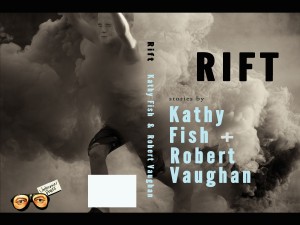
One of the things that makes RIFT so interesting is that I think its four sections are well chosen and organized and also their names and characteristics of each–FAULT, TREMOR, BREACH, and CATACLYSM–could also be used as an interesting way to approach writing a story’s plot and building tension. Can you talk more about the process of choosing these? And were they at all influenced with how you view plot or story?
Robert Vaughan and I wanted the collection to feel cohesive and to have its own arc that a reader could feel as she read it. Going through out stories we realized that some of the “rifts” were milder, some much more powerful. So we came to the organizing principle of setting the stories from lowest to highest intensity with synonyms for “rift.” Once wedecided this, the process of deciding which stories went where was surprisingly easy.
I personally don’t have strong views on plot, especially for flash fiction. As I tell my students, it’s more instructive for flash to think in terms of “movement.” So, yes, I believe that view of flash influenced my view of the overall arc of the book. It’s more in terms of subtle movement than epiphany or crescendo.
In “Sea Creatures of Indiana,” the ending is the type another writer can fall in love with. Image-wise it’s surprising and strange (“But to me, sea urchins are the spiny punk rockers of the sea…”), but by the end it feels like it’s one last, wonderful way of letting Benny return to the story even though he’s fled to college. What advice would you give to other writers who struggle with ending their stories?
Thank you, Megan! I struggled with that ending actually. There is another version out there in fact. I can’t decide which I like better. But one thing I do like very much is the type of ending that seems to jump off from the story itself. I like bringing in something new that resonates with the old. I think Joy Williams does this especially well. And for this story, I wanted Benny’s absence to be felt, but expressed somewhat gently. I was going for that weird mix of sadness and hope.
 In terms of advice, I’d say that a lot of times your story ended a few sentences up from where it is now. Resist the urge to tie things up into a neat bow. Resist the urge to take one more shot at making sure your reader “gets it.” Image or meaningful gesture or action is always better than your character looking out the window thinking about what he has learned.
How do you think teaching has influenced your writing?
I love teaching! Of course teaching reinforces one’s own learning. I’ve come to the very humbling conclusion that I still have so much to learn! Teaching makes you so much more aware of my own writing tics. Also, I’m always encouraging my students to stretch and innovate, to take risks. I sometimes have to remind myself to practice what I preach!
And on the subject of teaching, what are some stories you often assign when beginning a course on flash?
I have my own favorite flash writers whose stories I use to demonstrate what I love most about flash fiction: its openness to innovation. I have them read Lydia Copeland Gwyn’s one paragraphs stories that straddle the line between flash and prose poetry, i.e., “In the Air a Shining Heart” which was originally published in Night Train and may be read here at Fictionaut.
I have them read segmented flash fiction, such as Jeff Landon’s terrific “Thirty-Nine Years of Carrie Wallace” from this very journal.
And I always recommend that they read issues of Smokelong Quarterly and NANOfiction. I recommend the Queen’s Ferry Press terrific anthology, The Best Small Fictions, edited by Tara Masih. I love the Rose Metal Press anthology, Brevity and Echo as well. I take note of new published flash that I come across and have them read the ones I particularly love.
In ten words or less, what is your definition of flash fiction?
The best flash fiction is concise, innovative, and emotionally resonant.

 In September 2022 SmokeLong launched a workshop environment/community christened SmokeLong Fitness. This acclaimed community workshop is happening right now on our dedicated workshop site. If you choose to join us, you will work in a small group of around 15-20 participants to give and receive feedback on flash narratives.