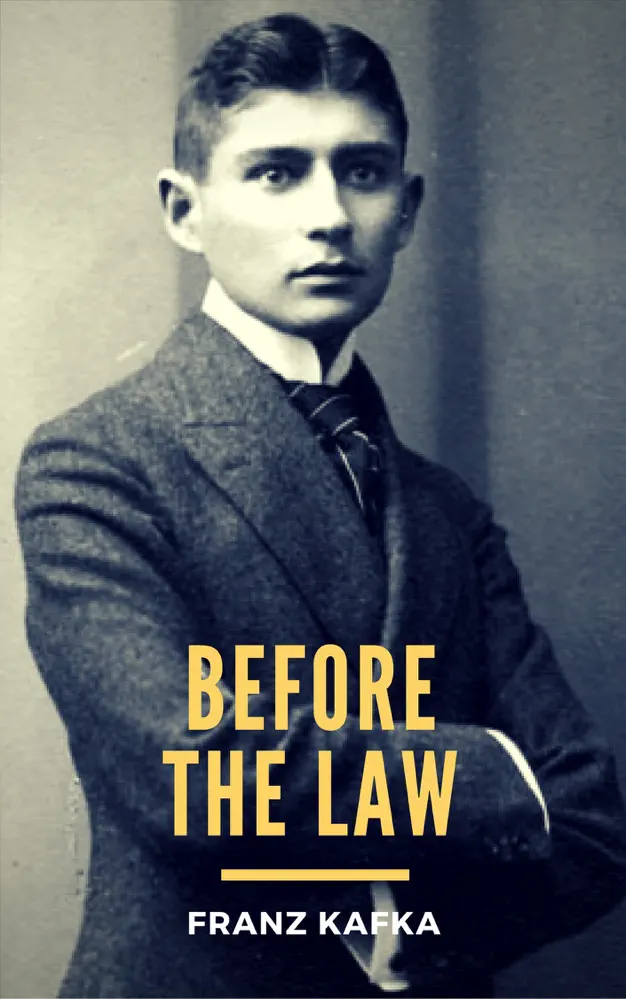
SmokeLong‘s “Flash, Back” series asks writers to discuss flash fiction that may be obscure or printed before the term “flash fiction” became popular, and tell us how these older or not widely known works are meaningful. In this edition, Brandon McNeice discusses Franz Kafka’s story “Before the Law.” Submit your own “Flash, Back” or other flash-related essays on our Submittable page!
by Brandon McNeice
Franz Kafka’s “Before the Law” is a flash fiction hidden in plain sight. It can be read alone, as one of his most famous parables, but it also lives inside The Trial, where a priest tells it to Josef in the cathedral. In that second life, the story becomes something stranger than an excerpt or inset. It is a complete miniature placed inside a larger machine; a flash embedded in a novel about judgment, delay, accusation, and inaccessible authority.
First published on its own in 1915 and later folded into The Trial, “Before the Law” has always had this double life. That doubleness is what makes the piece feel newly useful now. It is not only flash before flash had a name. It is embedded flash: portable, pressurized, complete in itself, and altered by the frame that holds it.
The story is simple enough to summarize almost entirely. A man from the country comes before the law and asks to enter. A doorkeeper says he cannot enter at the moment. The man waits. He offers bribes. He asks questions. He grows old. Near death, he asks why no one else has come to this gate in all these years. The doorkeeper tells him that this entrance was meant only for him, and now it will be closed.
A whole life passes, and almost nothing happens.
That is the story’s severity. Kafka gives us only the pieces required to create the pressure: a man, a gate, a gatekeeper, and time. No childhood. No village. No weather. No family. No explanation of what the man has done, failed to do, hoped for, feared, or believed. If Kafka gave the man a fuller biography, we might escape into diagnosis. We might say he waits because of class, temperament, religion, trauma, provincial innocence, or some private weakness. Instead, Kafka makes him entirely bare. The man is not a psychological profile. He is a posture. He is waiting for permission.
I keep returning to “Before the Law” because it understands a predicament we all recognize; the respectable habit of waiting for some other voice to say yes. I know that posture from writing. The submission queue. The closed door. The imagined authority on the other side. The humiliating hope that someone else’s permission might finally make the work real. Kafka’s man carries that posture to its terminal point. The doorkeeper says not now, and the man allows not now to become the shape of his entire life.
The most troubling detail is that the gate is open. If the door were locked, the parable would be easier. If the man were beaten, sentenced, dragged away, or formally condemned, we would know where to place our anger. But Kafka’s authority is subtler. The doorkeeper does not need to close the door. He only needs to make entrance seem unauthorized.
This is where the story becomes more than an allegory of bureaucracy or law. It is about the way an external command can become an interior arrangement. The man remains free enough to implicate himself, but not free enough to make the story simple. We cannot say with confidence that he should have walked through. Maybe he should have. Maybe the next guards really are more terrible, as the doorkeeper warns. Maybe he has been deceived. Maybe he has been tested. Maybe the law is open and inaccessible at once.
Kafka leaves all of these possibilities alive. Explanation would reduce it. The parable does not resolve itself into advice.
Inside The Trial, this uncertainty deepens. The priest tells Josef the story, and then the two begin to interpret it. Their interpretations do what interpretations often do in Kafka; they multiply the trap. The story becomes an object placed between them. They turn it. They dispute it. They look for some stable lesson inside it. But the parable does not yield.
Read alone, “Before the Law” is already a complete flash. Read inside The Trial, it becomes stranger. It is a story told to a man who is himself trapped before an invisible law. Josef is not merely hearing the parable. He is living it. The little story does not decorate the novel. It concentrates the novel’s terror and hands it back in miniature.
I would not call Kafka a hybrid writer in the contemporary submission-category sense. But “Before the Law” reminds us that literary forms have always been porous. The piece is fiction, parable, legal allegory, theological riddle, and embedded narrative at once. It is a flash inside a novel, complete by itself and transformed by its frame.
The final turn is devastating because it does not merely end the story. It revises the man’s life. For most of the piece, we may imagine the gate as one entrance among many, the man as one seeker among others. Then the doorkeeper tells him that this entrance was assigned only to him. The failure becomes intimate. He has not missed a general possibility. He has missed the one specifically curated for him.
Kafka does not tell us what lies beyond the gate. He does not tell us whether entrance would have saved the man. He does not tell us whether the doorkeeper is villain, servant, guardian, fraud, or necessary obstacle. He gives us the man, the open door, the long wait, and the terrible specificity of the ending.
A man comes to the gate made for him. He waits. The gate closes.
__________________________________
 Brandon McNeice is a Philadelphia-based writer and educator. His work has appeared or is forthcoming in Commonweal, Plough, Hunger Mountain, SmokeLong Quarterly, BULL, and Terrain.org. A two-time Best Small Fictions nominee, he writes about the daily negotiations by which people seek dignity, faith, and decency inside systems that are anything but simple.

 In September 2022 SmokeLong launched a workshop environment/community christened SmokeLong Fitness. This acclaimed community workshop is happening right now on our dedicated workshop site. If you choose to join us, you will work in a small group of around 15-20 participants to give and receive feedback on flash narratives.