Interviewed by Helen Rye
Tell us about your background and influences as an artist.
If I had a backdrop, in the sense of a portrait, I’d primarily have Ankara, Hollandis, George, Aso Oke, and lace. I’d also have a tinge of rust, soot, clay, handprints of palm oil, and the final touch of singed edges.
The list of those fabrics used to sew native attires were foremost, because my mother was an active seamstress in the 90s and early 2000s, and watching her make her far-from-basic technical choices on what chalked part to cut for the bodice, bust shaping, or sleeves. Working with those brightly coloured clothing materials required a very demanding conscientious attention to details, especially considering the intricacies of geometric patterns, leaves, vines, feathers, animals, sunbursts, and other abstract motifs. I was insanely drawn to them and soon began trying to replicate them on paper, before my eventual transition to fauna, my family portraits, superhero and cartoon characters.
I had a neighbour, a fellow seamstress to my mother, who was into embroidery like my mum was. There was also an artist down the street who sold artworks in a kiosk by the roadside. I remember watching him from a distance, fascinated by his artistic expression in reimagining the pastoral experience.
In other words, I was surrounded by art, and they spoke to me. From amateur paintings of barbershop hairstyles on walls, covers of classic Nigerian literature, public buses, walls and gates of private schools, and on other random eyesore structures that had no business making me lose sense of time, place and their deplorable conditions.
Among the hundreds of people who have influenced me in different ways, is Njideka Akunyili Crosby. I was drawn to her work for her masterful touch, exploring a number of interconnected themes, such as memory, family and relationships, cultural hybridity, migration, and so forth. I also draw inspiration from the works of Toyin Ojih Odutola, Anthony Azekwoh, and the offerings from a long list of digital artists across social media.
How did you develop your style and processes?
Slowly, I’d say, but steadily, and with very limited materials, whether it’s a ballpoint pen, a HB pencil, ledger paper, watercolour, crayons, carton, cardboard, school desk, the flyleaf of my father’s books, or the back of family photographs.
Discouraged by some acquaintances, I took a long break from that interest, and dedicated my artistic pursuit to poetry. In 2019, however, I dabbled into phone photography. It was a seamless transition into digital painting, trying my hands on different styles of painting on Autodesk Sketchbook on my android phone and later Procreate on a tablet, which is where I am currently. The number of times I surprised myself painting digitally really shaped how I approached any of my artistic endeavours.
The process of creation is fairly consuming and would be boring if it weren’t for music that helped lose sense of time. Whatever urgency I had was strictly reserved for the message in the work. It grew rapidly into an obsession. I’d go on to shoot over ten thousand pictures of textures, landscapes, objects, photographs of people I saved for reference, in a way that places them in my humble idea of a more suitable universe that served their quiet ambition.
My first breakthrough came from my amateur discovery of light, dark, color, editing photographs, which showed up in my art as painstaking attention I place on every grain or pixel I can zoom in to for the touch that makes them well connected to a whole. It is never my attempt, however, to be fastidious, or fussy about the tidiness of details. Rather, I focus on the necessary aspects of the work that reflects my life at that point in time. It is a long process of altering existing layers, mistakes that turn out to be just what I needed, experimentation, and aligning myself with the vision of the work.
Are there subjects and themes you return to?
I have recurring themes I just can’t seem to get enough of as I progress. They’re namely; grief, longing, loss, memory, innocence, and the garden variety, which I believe is the ultimate component identifiable in my work. How these thematic concerns come to be, or intersect, is up to the spirit of the moment supervising its creation. All I do is devote my time to work and stay open for astonishment.
Where do these preoccupations come from?
My understanding of migration, lost innocence, trauma, grief, and loss traces back to sectarian violence in 2000. The fallout is still visible: lives lost, families displaced, schooling interrupted, poverty entrenched, and entire communities left underdeveloped. What I had to work with was violence left behind in its wake.
Escaping a mob at six, hoisted by my father to peer over a fence was more than a practical act of checking whether it was safe to cross. At that moment, I, his first son, had imbibed the consciousness of collective eyes and tongue. The encouragement I received from people who engaged those realities in my work are proof of the burden that’s shaped my identity and connection to art in an unusual way. Every project feels like the last chance to leave something behind, hence, urgency, hence, archiving.
Do these ideas make their way into your writing?
Constantly, I’d say, and I’ve never tried to keep them apart. I’d, however, like to think I draw my most profound inspiration from viewing my own paintings or photographs. The output in my poetics are my symbolism, metaphors and imagery. They’re more animated by my reimagination of them in my writing.
What’s the story behind the Issue 92 cover art?
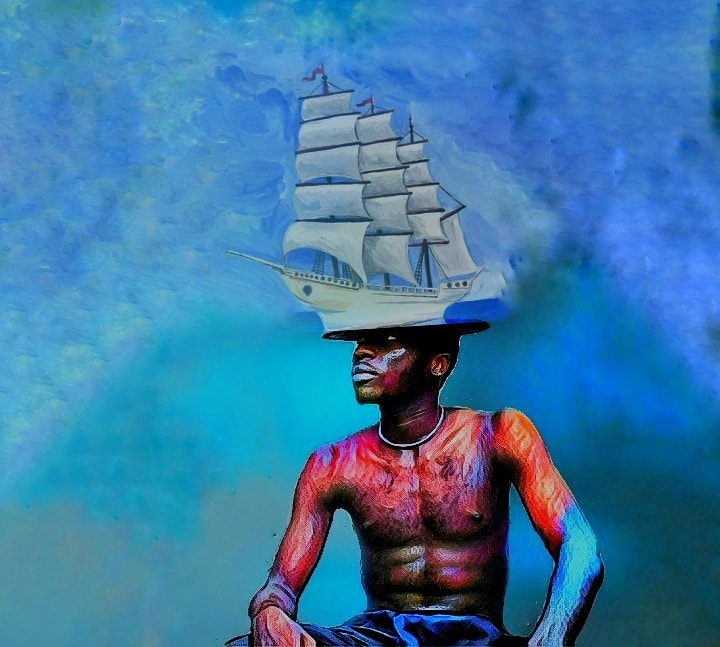
The surrealist image was created in 2022 using Autodesk Sketchbook. It was based on a photograph I took of my friend, Samuel Gaku, during our undergraduate studies at Ahmadu Bello University, Zaria. During that time, we had spoken at length about migration. That conversation stayed with me and eventually became the foundational substance from which the image developed.
The ship on the man’s head, in partial replacement of his hat, emerged as a symbolic element tied to those ideas of confronting migration, or embodying the dream of seeking a better life elsewhere. Greener pastures, as my countrymen put it. I wanted to create something symbolic, but accessible in representation of color, form, and expression.
What are you working on now?
I am reworking a few unfinished pieces, and painting mostly layers of backgrounds on which I intend to carry the story of my life.
___________________________
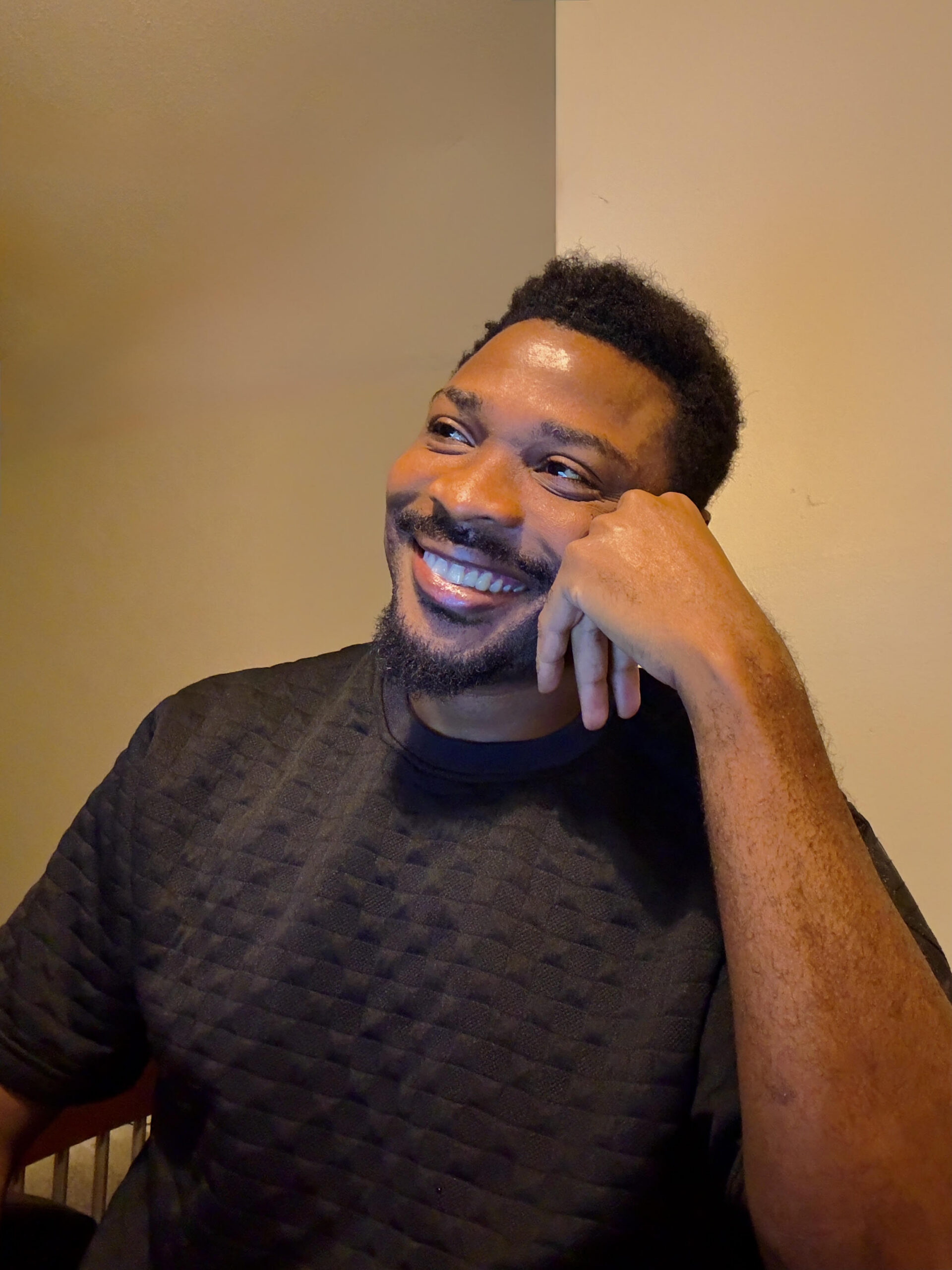 Martins Deep is a poet and digital artist based in Memphis, Tennessee, where he’s pursuing his MFA. He was named first runner-up in the 2024 Dream Foundry Art Contest. His work appears in Anathema Magazine, Reckoning Magazine, Josephine Quarterly, Chestnut Review, and other publications. Follow him on X @martinsdeep1.

 In September 2022 SmokeLong launched a workshop environment/community christened SmokeLong Fitness. This acclaimed community workshop is happening right now on our dedicated workshop site. If you choose to join us, you will work in a small group of around 15-20 participants to give and receive feedback on flash narratives.